Why Smart Security Teams Plan for CAASM Vendor Change
Why Vendor Change Is a CAASM Risk Worth Planning For
Recent acquisition activity in the security market has prompted reflection across security teams. It’s not about panic—it’s about preparation.
When a nimble CAASM platform faces the possibility of being absorbed into a much larger organization, security leaders naturally start asking forward-looking questions:
- Will product velocity slow?
- Will support models change?
- Will pricing and packaging evolve?
- And most importantly: Will this platform still meet our needs a year from now?
That uncertainty is prompting many teams to think ahead. Rather than waiting for changes to materialize, security leaders are evaluating what a long-term, resilient CAASM strategy should look like—and what options they’d want available if priorities or conditions shift.
This isn’t an argument for switching platforms—or a prediction that any specific outcome will occur. It’s simply an acknowledgment that CAASM has become foundational, and foundational tools deserve proactive planning rather than reactive decisions.
Common Considerations When Planning for CAASM Vendor Change
When security teams think through contingency planning in light of potential vendor changes, several consistent themes tend to surface:
1. Roadmap Confidence
Security leaders want clarity around where a platform is headed and how product decisions will be made over time.
Teams want to keep innovating at the pace they’ve grown used to. JupiterOne remains independent and focused on delivering fast, transparent value to security teams—with frequent updates and a roadmap driven by practitioner needs rather than external platform priorities.
2. Context-First Visibility
As environments grow more complex, list-based asset views often become limiting.
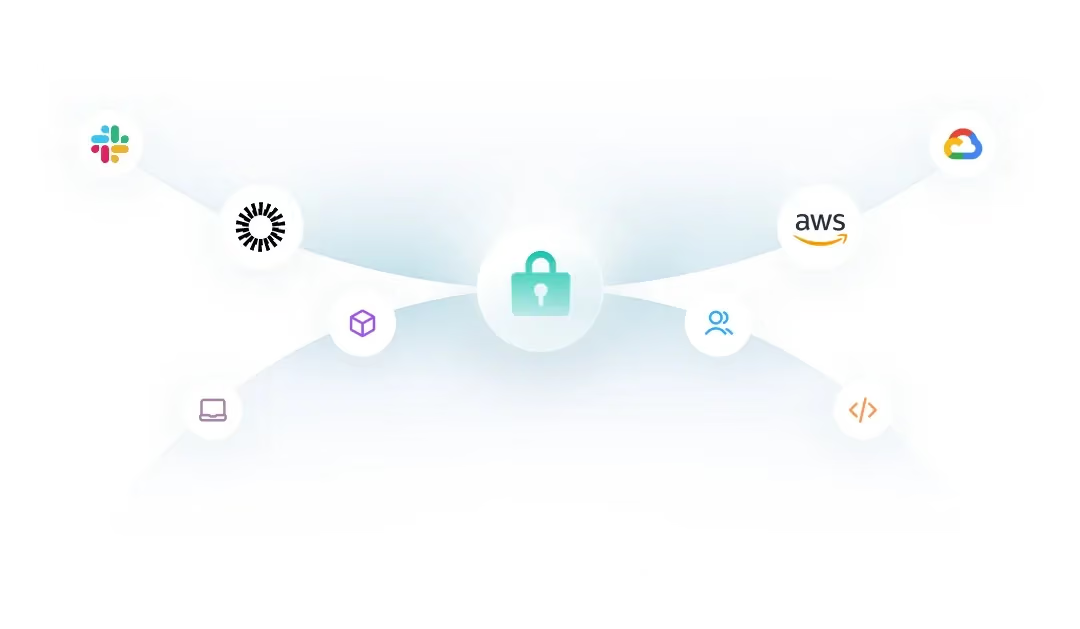
Graph-based architectures give teams a live, navigable map of assets, identities, vulnerabilities, and misconfigurations—making exposure, ownership, and relationships easier to understand and act on.
JupiterOne’s graph-based approach extends beyond built-in integrations. With the JupiterOne MCP Server, teams can continuously bring in new data sources and adapt their asset model as tools, technologies, and vendors evolve—without replatforming. This kind of extensibility helps ensure visibility strategies remain durable even as security stacks change.
3. Enterprise-Ready Scale
For large or fast-growing environments, performance consistency matters.
JupiterOne is designed to scale without degrading performance or compromising data integrity. Whether ingesting millions of assets or querying complex relationships, the platform remains fast, accurate, and dependable—an important consideration for cloud-native and high-ingestion environments.
4. Support and Partnership
When CAASM is foundational, support quality becomes strategic.
At JupiterOne, customers work directly with teams who understand their use cases. From onboarding to advanced queries, the support model is built for proactive security programs—not generalized, tiered assistance.
5. Continuous Assurance, Not Point-in-Time Visibility
Visibility alone isn’t enough—especially during periods of change.
As vendors, tools, and environments evolve, teams need confidence that security and compliance controls continue to function as expected. JupiterOne’s built-in Continuous Controls Monitoring (CCM) helps teams continuously validate controls across assets, reducing reliance on manual audits or point-in-time assessments.
By providing ongoing assurance, CCM helps teams maintain confidence in their security posture—even as underlying systems, vendors, or architectures shift.
JupiterOne as a Long-Term CAASM Option
When teams evaluate CAASM platforms as part of contingency planning, JupiterOne is often considered because of:
- Graph-based intelligence that maps relationships, not just inventories
- Real-time query power without rigid workflows or wizard constraints
- Extensibility through MCP Server, enabling adaptation as tools and data sources change
- Built-in continuous controls monitoring (CCM) for ongoing assurance
- Proven ability to scale without performance degradation or loss of data integrity
- An independent roadmap, unaffected by acquisition uncertainty
Planning Ahead—Without Committing Yet
We’re not suggesting teams need to make an immediate change. But for organizations that want to stay in control of their security visibility—before market or vendor dynamics force reactive decisions—now is a reasonable time to understand their options.
To help with that planning, we’ve created two resources:
Your security foundation should evolve at your pace—not someone else’s roadmap.