The Ultimate Guide to Continuous Threat Exposure Management (CTEM)
What is CTEM?
Continuous threat exposure management (CTEM) is an approach that surfaces and actively prioritizes the biggest threats to your business. In 2022, Gartner introduced the concept as a pragmatic, systematic approach that would allow organizations to manage cyber threats as an ongoing program instead of a string of one-off projects.
Because change is constant, the industry needed an operating model that could keep pace with shape-shifting attack surfaces. In a world where remote work and new SaaS apps add assets faster than a quarterly scan can find them, a CTEM program closes that distance.
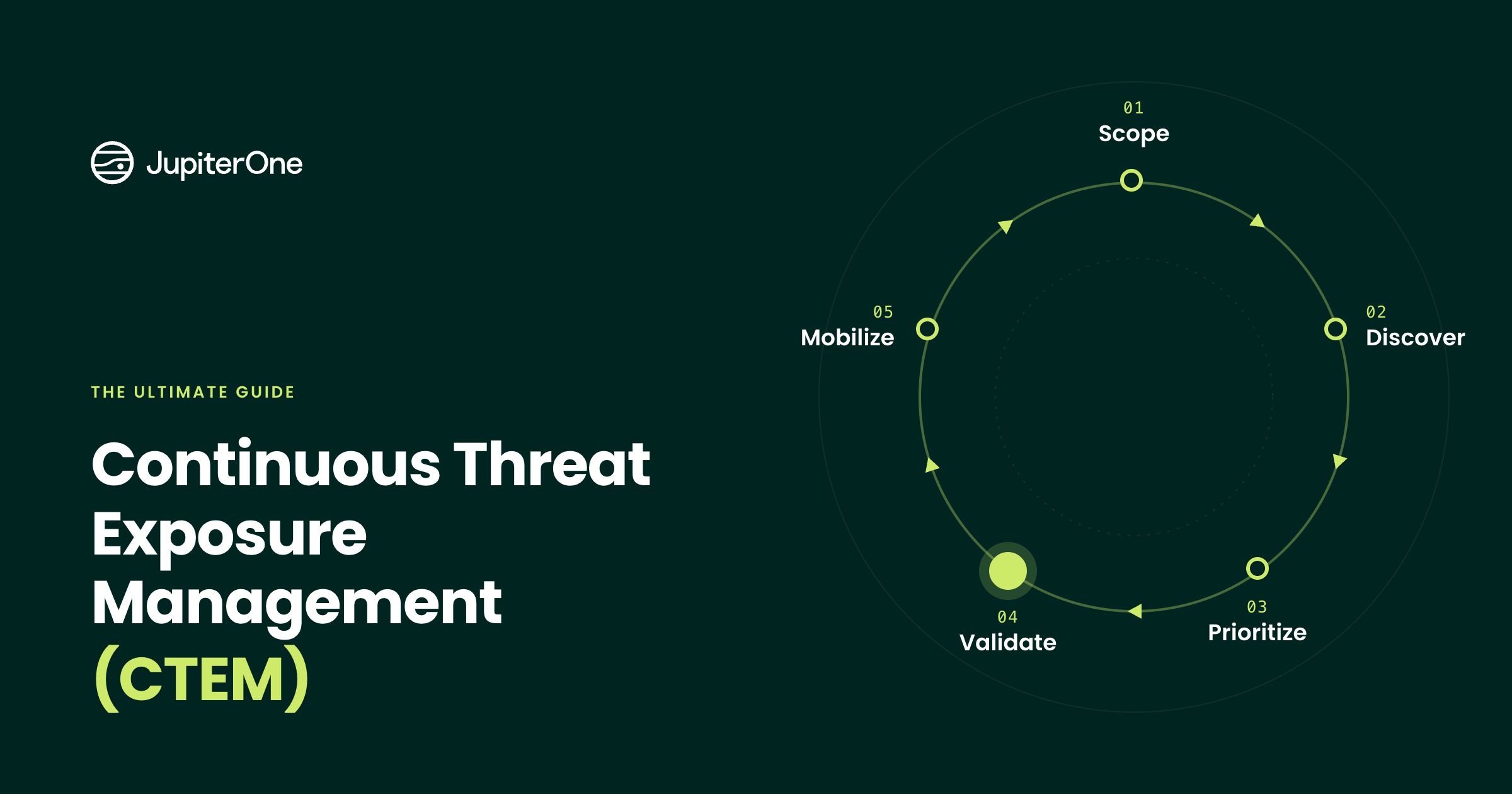
The CTEM framework is commonly outlined by five distinct steps in a continuous cycle (scoping, discovery, prioritization, validation, and mobilization). Because CTEM doesn't rely on periodic scans or static inventories, it can prioritize exposures that matter in the moment rather than alerting security teams to chase down every potential vulnerability. And because CTEM maps signals to attack paths and business risks, organizations can triage exposures not only on severity, but on exploitability and blast radius.
The five stages of the CTEM cycle
CTEM creates a closed-loop system. Each stage feeds the next, and what you learn at the end sharpens the scope for the following pass. If you're adopting the CTEM framework within your organization, this is the five-stage process you should expect:
1. Scope
Start by deciding what the program covers. Business stakeholders should weigh in, because they know which systems carry the most revenue or regulatory risk. Many programs begin with the external attack surface and SaaS applications, then widen from there.
2. Discover
Discovery finds assets and the weaknesses on them, from software vulnerabilities to misconfigurations, and it keeps running. A scan from last month says little about the cloud workload someone spun up on Tuesday. Identity risks belong here too, such as overprivileged accounts and stale credentials, along with the attack vectors an adversary is most likely to use.
3. Prioritize
Most organizations have more findings than they can fix. Prioritization ranks exposures by how likely an attacker is to exploit them and by the potential impact on the business. Severity scores alone cannot answer that. Asset criticality and existing security controls change the ranking, and so does whether a flaw is under active attack. Business priorities set the final order.
4. Validate
Validation checks whether an exposure can be exploited in your environment. Teams analyze the attack paths that lead to an asset and use attack simulations or penetration testing to confirm that a theoretical flaw gives an attacker a real route in. Path analysis also shows blast radius, meaning how far an attacker could move after the first foothold. This step tests your response plan as well. If the plan would not stop the attack, you find out before an attacker shows you.
5. Mobilize
Mobilization turns findings into fixes. Remediation efforts usually involve people outside the security team, so this stage clears the approval and implementation hurdles that slow them down. Assign each fix to an owner and route tickets into the tools IT teams already use.
CTEM vs. traditional vulnerability management
While both traditional vulnerability management and CTEM work to reduce risk, they do so with fundamentally different approaches. Where traditional vulnerability management scans and then hands over a list of ranked CVEs, CTEM takes a broader approach. Rather than checking items off a list, CTEM adds business context and tests whether an attacker could use each flaw. Then it follows the fix through to completion.
The differences here matter because of speed. AI-driven adversaries don't file change requests or wait on patch windows. When they find an exposure, they move — and fast. The window between vulnerability disclosure and weaponization keeps shrinking, while the average enterprise remediation cycle — triage, ticket, change approval, patch, verify — has barely adapted in a decade.
Tools and solutions commonly used for CTEM
Because CTEM is a program rather than a product category, exposure management platforms exist to operationalize the five-stage cycle. No single product covers every stage, so most combine several categories of tools.
Many security leaders favor a platform that unifies several of these categories, since stitching together a dozen point tools recreates the silos CTEM is meant to remove.
How CAASM supports a CTEM program
Cyber asset attack surface management (CAASM) gives a CTEM program its foundation. A CAASM platform pulls data from the tools you already run and builds a single inventory of devices, applications, cloud services, and user accounts. That inventory covers known and unknown assets, which is where blind spots hide.
With the inventory in place, the platform integrates with vulnerability scanners and threat intelligence sources so teams can rank vulnerabilities by risk across every asset. It also surfaces misconfigurations such as open ports or loose firewall rules, which shrinks the attack surface. Automated workflows carry findings to the people who fix them, and feedback from each incident improves the next pass through the CTEM cycle.
JupiterOne's graph-native architecture suits this work because it maps how assets, identities, and permissions connect. Those connections are the attack paths.
CTEM in on-premises and cloud environments
Yes, CTEM works in both. It is a process, so it applies wherever assets live. The tools change by environment, but the five stages stay the same.
Cloud environments add pressure because assets appear and disappear in minutes, which makes continuous discovery necessary. On-premises systems often run older software that cannot be patched on a normal schedule, so validation and compensating security controls become more important. Hybrid organizations need one view across both, because an attack path that starts with a phished identity can end in either one.
Which organizations should adopt CTEM
Gartner predicted that by 2026, organizations that prioritized investments in CTEM would be three times less likely to suffer a breach. In that sense, everyone at risk of a breach can benefit from the program. This is especially true for companies with large cloud footprints or a distributed workforce, and for teams whose scan results outpace the staff available to fix them. Regulated industries such as finance and healthcare benefit from the audit trail that continuous validation produces.
That isn't to say that smaller teams won't also benefit. The approach may vary and start with a narrower scope, such as the external attack surface or a short list of critical assets.
Common challenges when starting with CTEM
CTEM has a long list of benefits, but every approach comes with tradeoffs. Organizations may encounter several challenges, including:
- Asset inventories go stale. When discovery depends on manual updates, the scope drifts from reality within weeks. Automated, continuous ingestion from the sources you already have keeps the inventory current.
- Everything looks critical. When severity scores flag thousands of findings as urgent, teams cannot choose. Asset criticality and business context narrow the list to what to fix first.
- Findings stall between teams. Validation confirms a risk, then the fix sits in a queue because security and IT teams use different systems and different priorities. Shared tickets and agreed ownership shorten that wait.
- Budget and buy-in are limited. Business stakeholders fund what they can measure. Track mean time to remediate and the share of critical assets under continuous monitoring, and report both in business terms.
Benefits of CTEM
Security teams often have plenty of data but lack the context to prioritize it. CTEM makes that possible and offers these benefits:
- Reduced risk exposure. CTEM allows teams to focus on what is actually most critical in the environment. If an exposure can access crown jewels, remediation efforts are placed there because it delivers measurable risk reduction.
- Proactive security posture. Attack simulations help teams test response plans before a real attack occurs, while ongoing risk assessment helps connect security investments to business objectives.
- Improved analyst efficiency. By prioritizing meaningful exposures, CTEM helps security teams spend less time chasing alerts and more time addressing material risks.
- Simplified compliance reporting. Because everything is mapped and in real time, it streamlines compliance reporting and keeps security current.
Getting started with a CTEM program
Whether you’re consolidating point solutions or building a CTEM program from scratch, the same eight questions separate platforms that manage exposure from platforms that manage lists:
- Does it cover the full attack surface?
- Does it deduplicate across sources, or just aggregate?
- Can it explain every prioritization decision?
- Does prioritization understand relationships?
- How does it validate mitigations?
- Can your AI use it?
- Does mobilization go beyond ticket creation?
- Does it consolidate tools or add one more?
JupiterOne was built to answer all eight — and the fastest way to pressure-test that claim is a demo against your own environment.
JupiterOne's graph-native platform builds a continuously updated inventory of your assets and the relationships between them, so you can see which exposures sit on critical assets and which attack paths lead to them.
See how JupiterOne can support your CTEM program.
Frequently asked questions
What tools or solutions are commonly used for CTEM?
Most programs combine several tool categories. CAASM and external attack surface management tools build the asset inventory. Vulnerability scanners and cloud posture tools find weaknesses. Threat intelligence feeds support prioritization, and penetration testing or attack simulation tools handle validation. Ticketing and workflow automation tools carry fixes to the teams that own them.
You can see a list of some of the top vendors that support the CTEM lifecycle here.
How does CAASM support a CTEM program?
CAASM platforms build a single inventory of devices, applications, cloud services, and user accounts, including assets the security team did not know about. That inventory feeds scoping and discovery, and its integrations with scanners and threat intelligence support prioritization. Automated workflows then carry findings to the teams that fix them.
Are there common challenges when starting with CTEM?
Four problems come up often: asset inventories that go stale, too many findings marked critical, fixes that stall between security and IT teams, and limited budget or buy-in. A narrow starting scope and an automated inventory address the first two. Shared ownership and business-level metrics help with the rest.
What types of organizations should consider adopting CTEM?
Any organization with an attack surface it cannot fully see is a candidate. The payoff comes fastest for companies with large cloud footprints or distributed workforces, and for teams whose scan results outpace their capacity to fix them. Small teams can begin with a narrow scope.
Does CTEM work for both on-premises and cloud environments?
Yes. CTEM is a process, so it applies wherever assets live. Cloud environments make continuous discovery necessary because assets change in minutes. On-premises systems often run older software, which raises the value of validation and compensating security controls. Hybrid organizations need a single view across both.
How do you measure whether a CTEM program is working?
Track mean time to remediate and the share of critical assets under continuous monitoring. Add the number of attack paths closed each quarter to show risk reduction. Report the results in business terms so stakeholders can tie them to security investments.