The Ultimate CAASM Guide for 2026
Companies are moving faster than ever. API-first architecture and cloud-first infrastructure make it easier to ship new products and experiences for customers, and remote work keeps distributed teams productive without slowing anything down. But that speed comes at a cost. Every new cloud account or API adds another cyber asset to track, and remote work adds even more devices and endpoints to watch. The bigger that universe gets, the harder it becomes to understand the full scope and impact of an attack or breach.
Security teams can't protect what they can't see. That single problem, more than any tool gap or headcount shortage, drives most breaches, missed audits, and after-hours incident calls. An attack surface management strategy is no longer optional, but finding a platform that works can be difficult. Cyber Asset Attack Surface Management, or CAASM, is built for exactly this problem.
This guide covers what CAASM is, why security and IT teams have adopted it so fast, how it works, and what to look for if you're evaluating a solution.
What Is CAASM (Cyber Asset Attack Surface Management)?
Cyber Asset Attack Surface Management (CAASM) empowers security teams to overcome asset visibility and exposure challenges (Gartner). This technology enables security and IT teams to see all assets (internal and external), query consolidated asset data, identify the scope of vulnerabilities, and see gaps in security controls. The scope of “assets” captured by CAASM is broad, including a wide range of resources such as devices, endpoints, servers, software applications, cloud workloads, code repositories, users, and access permissions, providing a comprehensive view across the entire digital ecosystem.
CAASM platforms provide security and IT teams with the ability to:
- Gain complete visibility across all their assets (both internal and external, cloud and on-premise) via API integrations with their existing tools
- Query their deduplicated, consolidated data using natural language or advanced query languages such as JupiterOne Query Language (J1QL) to quickly investigate exposures, answer security questions, and understand asset relationships
- Identify the scope of exposures and gaps in security controls
- Accelerate incident response and mitigate issues
Why CAASM Matters for Attack Surface Management
The world has changed. In simpler times, companies could track their assets using spreadsheets and network scanners. But once cloud infrastructure, remote work, and SaaS sprawl multiplied the number of digital assets an average organization runs, that approach stopped working.
Modern environments are fluid with new assets and their associated risks appearing and disappearing by the hour. Whether it's a developer spinning up a cloud instance or a team adopting a SaaS tool without notifying IT, each one creates a blind spot that a manually tracked inventory won't catch.
Today, it’s difficult for IT, security, and engineering teams to answer even the most basic questions about their complex environments, attack surface, and cyber assets. That's where CAASM tools like JupiterOne come in to help.
Shadow IT and Security Blind Spots
How do you secure what you can't see or don't know you have? This is where shadow IT becomes a real problem. Security tools each define "asset" differently and rarely talk to each other, which leaves blind spots between them. You end up with partial visibility from five or six different consoles and no single source of truth. CAASM closes that gap by giving every team, from security operations to compliance, one unified view of the full asset inventory and security posture.
How CAASM Works: Asset Discovery, Aggregation, and Query
CAASM platforms typically work in three steps.
1. Asset Discovery and Integration
The platform connects to your existing security tools through APIs, without requiring new agents on every device. This includes cloud providers, identity and access management (IAM) systems, endpoint protection, vulnerability scanners, and configuration management databases.
2. Data Aggregation for a Unified Asset Inventory
Asset data from all those sources gets pulled into one place, deduplicated, and enriched with context like ownership, asset criticality, and relationships between assets.
3. Querying Cyber Assets for Full Visibility
Instead of pulling reports from each tool separately, teams can ask direct questions of the whole asset inventory: which assets are missing endpoint protection, which cloud accounts have no owner, which exposed assets tie back to a specific business unit. Some CAASM platforms use a graph data model for this step, which makes it possible to trace relationships between assets, not just list them.
JupiterOne supports both natural language queries and J1QL. To get security teams through hectic days, requires quick investigation of cyber assets, being able to identify exposures, and understand relationships across identities, cloud resources, applications, and infrastructure. This flexibility makes it easier for both technical and non-technical users to answer complex security questions without manually searching across multiple tools.
Use Cases and Key Benefits of a CAASM Solution
Full Asset Visibility Across Hybrid Environments
CAASM creates a unified, continuous view of your organization’s complete asset inventory by consolidating and enriching data from multiple systems. Currently, only 13% of organizations can perform continuous asset inventories, while 41% say incomplete asset inventories are a top barrier to cyber risk management (Qualys). Organizations can improve this with CAASM, by understanding:
- How many cyber assets exist.
- Assets in use that are not listed in the system of record.
- AWS, GCP, and Azure cloud asset inventory and cloud security posture.
Fewer Blind Spots Through Continuous Monitoring
Continuous monitoring surfaces unmanaged, unmonitored, or newly added assets before they turn into an incident. With a complete view across your entire cyber asset inventory, you can improve cybersecurity hygiene and security posture based on details, including:
- The percentage of assets unmanaged or unmonitored by security tools.
- Which assets have recently been added, removed, or modified.
- Which findings have the greatest risk of critical impact.
Faster Incident Response
When a breach happens, CAASM accelerates SecOps response times by identifying specific, critical risks and the blast radius associated with vulnerability findings and incidents. Teams have the necessary context for triage and response:
- Which attack scenarios have the greatest likelihood and impact.
- The blast radius of a compromised device, user, or other asset.
- Which applications are vulnerable and where they are operating.
- How to reduce noise from scanners and focus on the most important vulnerabilities.
Better Risk Prioritization for Vulnerability Management
Asset context (ownership, criticality, exposure) helps vulnerability management teams fix what matters most first, instead of working a flat list by CVSS score alone. Security teams can see:
- Who is responsible for fixing a vulnerability found on a specific asset.
- The potential blast radius if a user endpoint is compromised.
- Findings with high EPSS (Exploit Prediction Scoring System) scores.
- If an attacker can use any exposure to access critical business assets.
- Any actively exploitable vulnerabilities.
Simplified Risk Assessment and Compliance
A current, accurate asset inventory makes it far easier to produce evidence for frameworks like SOC 2, NIST, or ISO, and to spot compliance drift as it happens. Automated testing and evidence collection is critical for teams with limited resources, budget, and time. With CAASM solutions like JupiterOne, it's possible to map controls and framework relationships. In one view you can understand:
- Evidence of compliance with particular requirements.
- Endpoints out of compliance with baseline configurations and patch management.
- Compliance status against custom SOC2 controls.
- Existing security gaps.
- How compliance gaps compare across frameworks.
What are the most important features of a CAASM solution?
CAASM technology should continuously monitor all cyber assets by integrating existing tools. A CAASM platform correlates data at scale and provides querying capabilities to find potential security gaps and compliance drift.
An effective unified CAASM solution helps you map your assets and asset relationships on a graph-based system allowing you to ask any question of your asset collection. You can quickly make logical connections between identities, cloud workloads, git repositories, code commits, and much more. This relationship context makes it possible to ask extremely complex questions and get answers within seconds.
CAASM is the knowledge base for your entire cybersecurity posture and enables you to quickly and automatically analyze complex attack surfaces. The more asset metadata you have, the more connections you can understand and govern across your cyber asset environment.
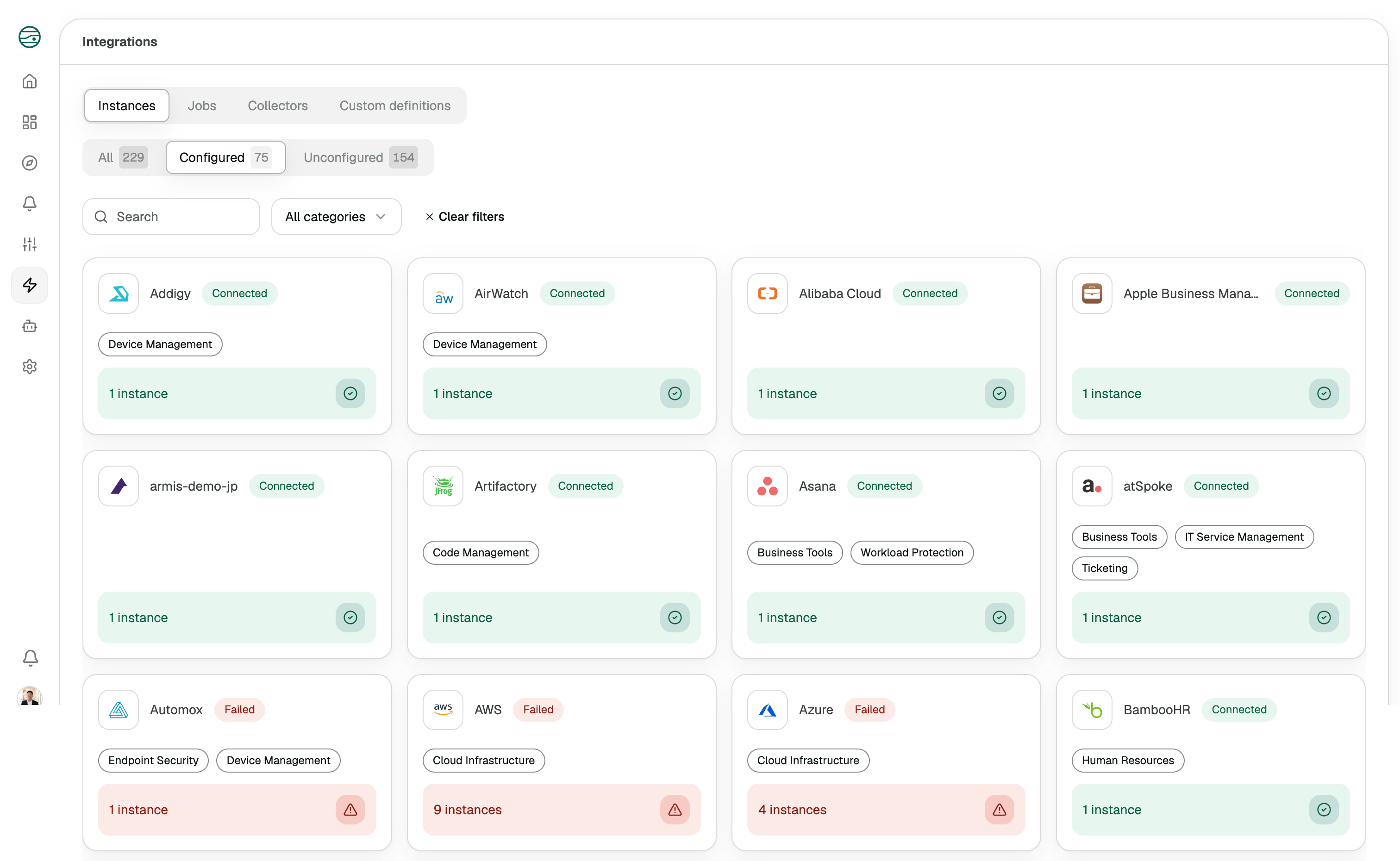
JupiterOne's comprehensive visibility connects all your integrations and cyber asset data into one platform.
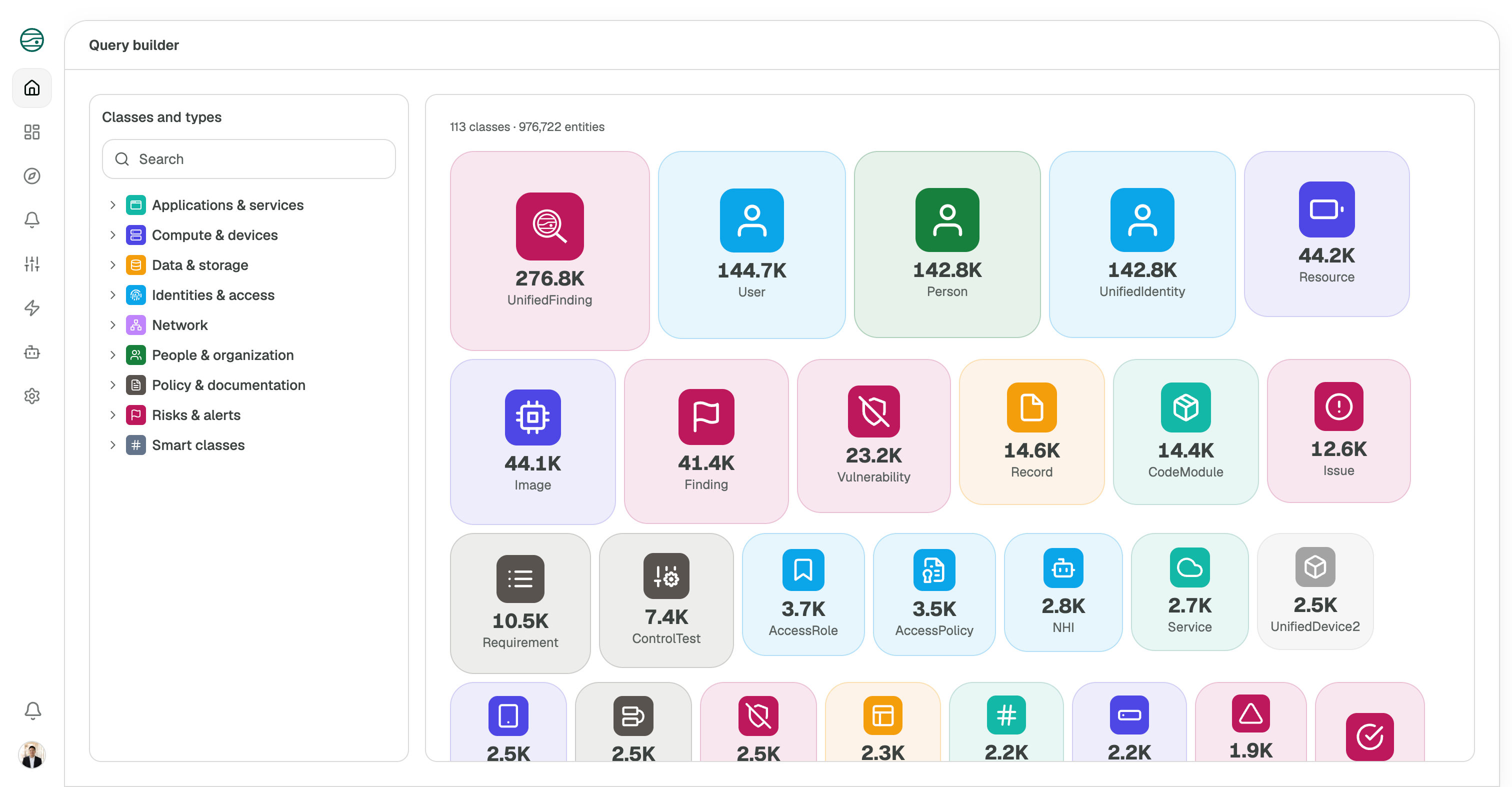
The ability to query your cyber assets is critical to understanding the blast radius of an impacted asset and accelerate SecOp detection and response.
CAASM Solution Feature Checklist
Frequently Asked Questions About CAASM
When was CAASM first introduced?
Attack Surface Management, as a practice, isn't new. Security teams have worked to find and reduce their exposure since the earliest network vulnerability scanners appeared in the 1990s. The core idea behind ASM—know what you have so you can protect it—has driven IT asset management and vulnerability management for decades.
In 2021, Gartner introduced the term CAASM for a slice of that work. In its Hype Cycle for Network Security, CAASM became an emerging category. Gartner defined CAASM as a technology that gives security teams a unified, queryable view of internal and external assets through API integrations with existing tools.
What are some of the most popular CAASM tools?
JupiterOne is one of the original CAASM vendors named in Gartner's 2021 Hype Cycle. For a closer look at how specific platforms compare, see our breakdown of CAASM platforms and how they stack up here.
How can CAASM complement other technologies like SIEM, SOAR, XDR, and Vulnerability Management?
Security relies on knowledge of your infrastructure and cyber assets. Understanding what exists, where it exists, and all pertinent meta-data around each asset makes it possible to create an effective security program.
CAASM solutions like JupiterOne integrate with technologies like SIEM, XDR, and VM tools to connect assets beyond the cloud into a powerful knowledge graph. The more data you connect, the more you can see and understand across your cyber asset universe. Having queryable access to an up-to-date cyber asset knowledge base is complementary to watching all of the events as they go into and out of the infrastructure. While most tools focus on the events of the system, CAASM tools focus on detecting issues and changes that occur within the assets themselves.
How does CAASM compare to External Attack Surface Management (EASM)?
External Attack Surface Management (EASM) solutions like Cortex Xpanse and CyCognito are most commonly used to discover unknown external-facing assets and networks. They identify infrastructure-based vulnerabilities for an organization’s security operations program. But what they can’t tell you is what’s actually inside your environment today.
CAASM solutions like JupiterOne augment current EASM tooling and existing external asset data by consolidating all data to give teams complete visibility across all their assets (both internal and external, cloud and on-premise) via API integrations. The combined structural data across all cyber assets gives companies the complete context they need to accelerate their security operations. You can learn more in this article comparing CAASM and EASM.
How is CAASM different than Cloud Security Posture Management (CSPM)?
CSPM tools check cloud configurations against a set of known misconfiguration patterns. The category has grown beyond early tools like Dome9, DivvyCloud, and Prisma Cloud to include a wider range of infrastructure and workload scanners. The reality is that most CSPM platforms still function as a black box. They use the same standard checks across every environment, with little flexibility to add custom rules, monitor configuration baselines unique to your environment, or see the relationships between the assets they're scanning.
The difference comes down to scope and depth. CSPM audits configuration settings within cloud environments. CAASM builds a full, queryable inventory of every asset, cloud and non-cloud, along with how those assets relate to each other. A CSPM tool can tell you if a setting is misconfigured. A CAASM platform can tell you which asset that setting lives on, who owns it, and what it's connected to.
How is CAASM different than an Exposure Assessment Platform (EAP)?
Exposure Assessment Platforms (EAPs) help organizations identify, prioritize, and remediate security exposures by combining signals from vulnerability management, attack path analysis, threat intelligence, and risk scoring. Using EAPs, security teams understand which risks are most likely to impact the business and should be addressed first.
CAASM serves a different purpose. It creates a complete, continuously updated inventory of cyber assets by aggregating and correlating data from across security and IT systems. With this, security teams can see and understand where exposures exist, who owns affected assets, and how assets are connected.
The technologies are complementary. An EAP helps answer "Which risks should we prioritize?" while CAASM answers "What assets do we have, how are they related, and where are our visibility gaps?" Together, they provide the context and prioritization.
How is CAASM different than a Configuration Management Database (CMDB)?
A Configuration Management Database (CMDB) and a CAASM platform both track assets, but they serve different purposes. A CMDB is the system of record for IT operations. It documents known assets, their configurations, and their relationships to support processes like change management and incident response. A CAASM platform focuses on security visibility by connecting to the tools you already use—such as EDR, vulnerability scanners, cloud platforms, identity providers, and endpoint management. This helps you to build a complete, up-to-date view of your attack surface.
CAASM doesn’t replace CMDB, it validates and enriches it. By correlating data across multiple systems, CAASM can identify unmanaged devices, assets missing security controls, stale records, or discrepancies between inventories. TL;DR, a CMDB tells you what should exist, while CAASM helps you verify what actually exists so security teams can find and close visibility gaps before attackers do. Platforms like JupiterOne take this a step further by allowing teams to investigate asset relationships using natural language, J1QL, and AI-powered workflows that accelerate security operations.
Get Started with CAASM
You can't secure what you can't see. CAASM gives security teams the complete, connected view of their cyber assets needed to reduce blind spots, prioritize risk, and respond with confidence.
JupiterOne takes CAASM further with a live cyber asset knowledge graph, natural language search, J1QL, JupiterOne AI, and MCP support—giving your team the visibility and context to answer complex security questions faster. If you're ready to eliminate asset blind spots, it's time to see what JupiterOne can do.