The AI data layer for security teams
Every asset. Every identity. Every relationship. One graph grounded enough for AI to reason over and fast enough for your security team to act on.
Security teams don't have a data problem. They have a data trust problem.
Security data is scattered across disconnected tools, leaving AI to guess instead of reason.
JupiterOne's Security Graph unifies every asset, identity, vulnerability, and AI entity into one trusted knowledge layer, delivering grounded answers instead of hallucinations.
Why a graph-native AI data layer matters for every role
Every team gets a different answer out of the same graph, because every team asks it a different question and none of them have to wait on a data team to reconcile exports before they can start.
01.
Get defensible, board-ready answers
"What's our actual AI exposure" — grounded in relationships and blast radius, not a spreadsheet estimate assembled the night before a board meeting. When the question changes mid-meeting, the answer can change with it, in real time, instead of "let me get back to you next week."
02.
Model your environment the way it actually works.
Your environment isn't a list — it's a network of relationships. JupiterOne lets you model, query, and reason about those relationships using J1QL across 200+ integrations. Build the asset foundation the rest of your stack depends on — without custom engineering, without stitching CSVs together at 11pm.
03.
Get full context on any asset in seconds.
Stop pivoting across five dashboards to answer one question. JupiterOne pulls asset, identity, vulnerability and compliance context into one view — so you can triage alerts, trace blast radius, and close investigations faster. Ask in plain English or J1QL. Either way, you get the answer and the evidence.
04.
Continuous assurance. Zero audit surprises.
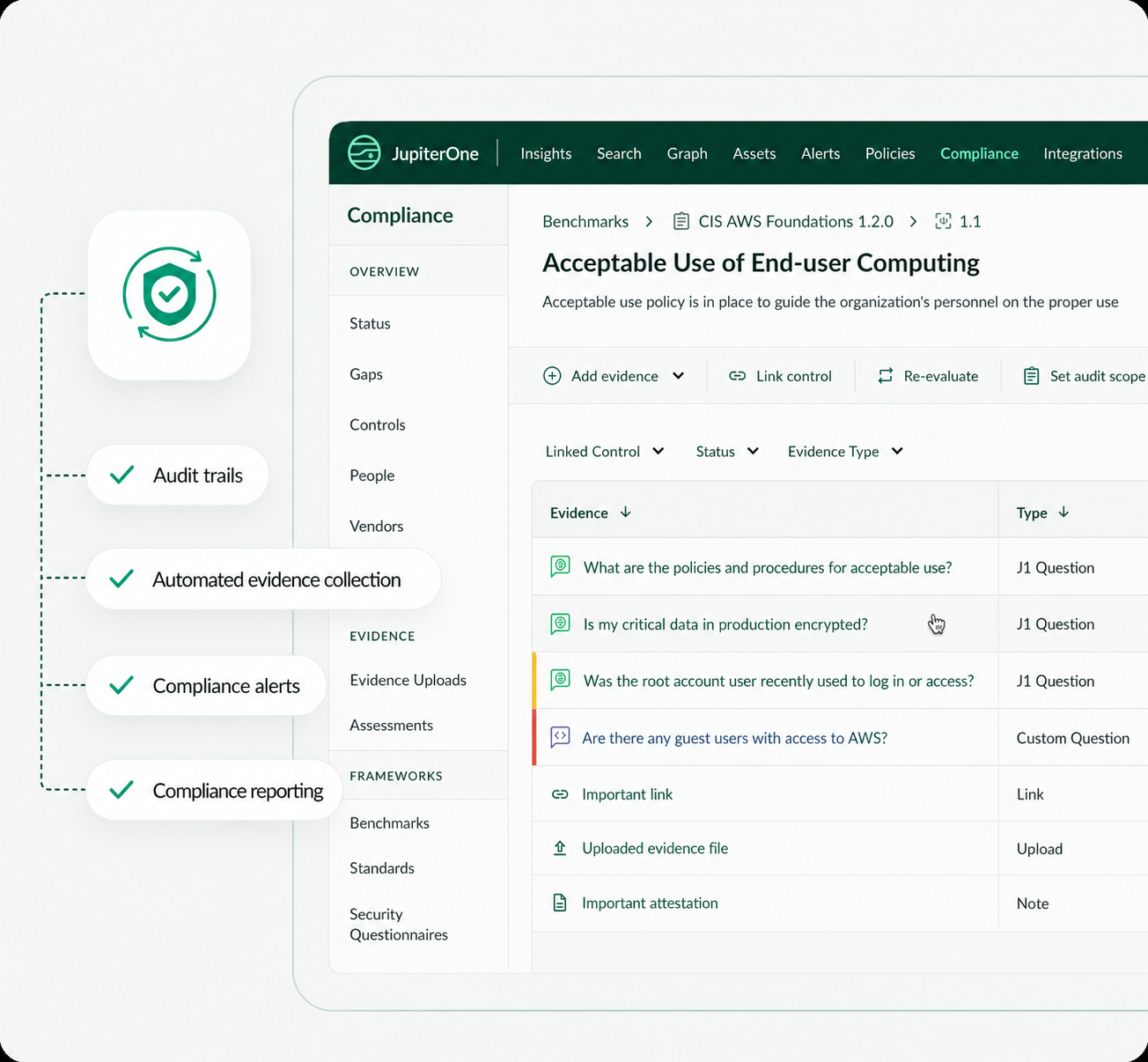
Regulators now demand continuous control effectiveness — not annual snapshots. JupiterOne CCM evaluates every control against live evidence across cloud, identity, and SaaS, then translates it into board-ready risk metrics and a shared language across business, security and audit. Eliminate redundant control testing, close gaps before they land and elevate cyber risk from a compliance conversation to a strategic one.
Why AI needs a trustworthy data foundation
Every security leader faces the same two questions, both caused by security data that lacks relationship context. AI agents only make that gap wider.
The vulnerability prioritization problem
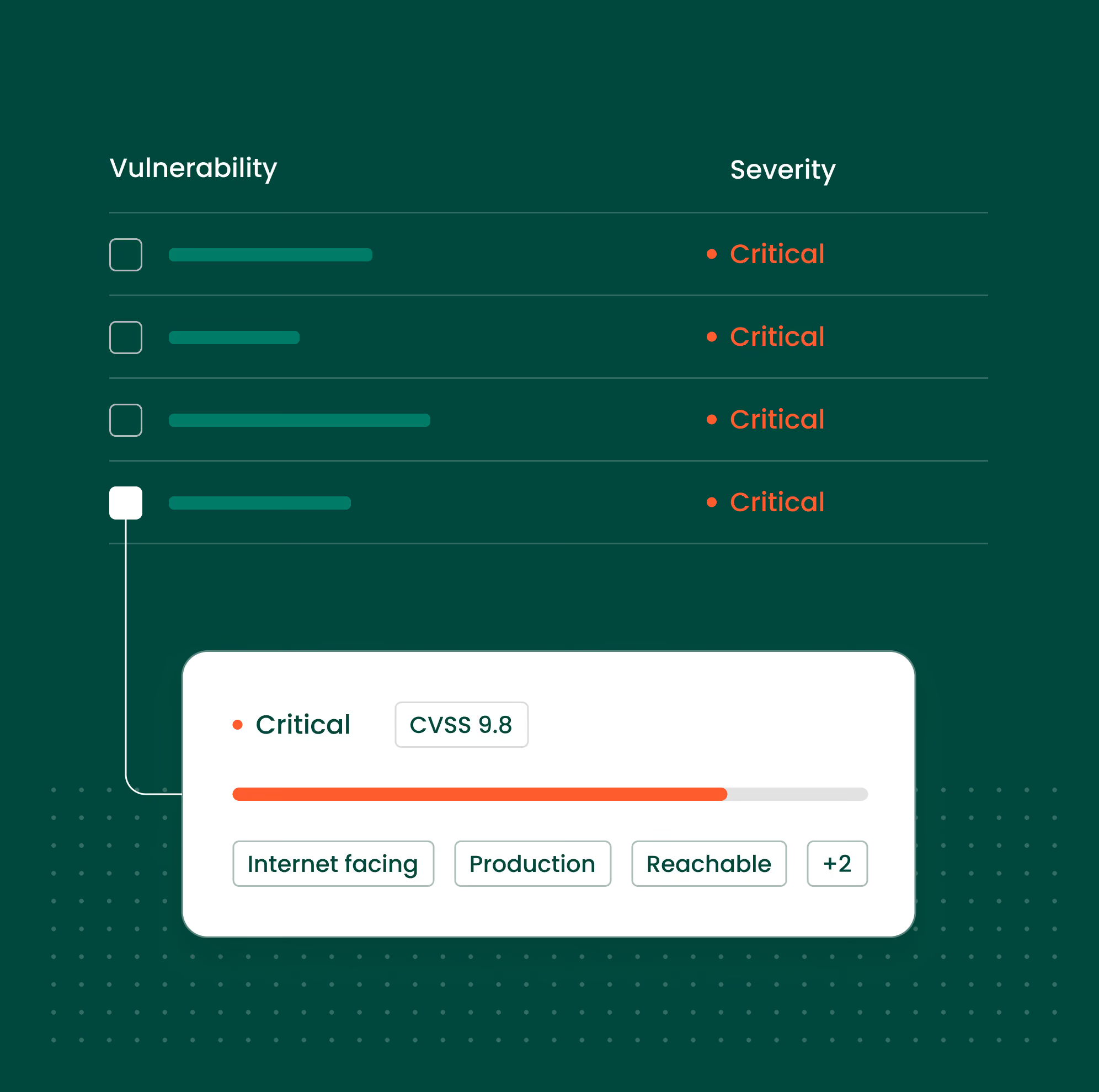
"I have more vulnerabilities than my team can patch in a lifetime. How do I know which ones actually matter?"
Traditional scanners prioritize CVSS scores, not real-world exposure, causing teams to patch severity instead of risk.
The AI exposure blind spot
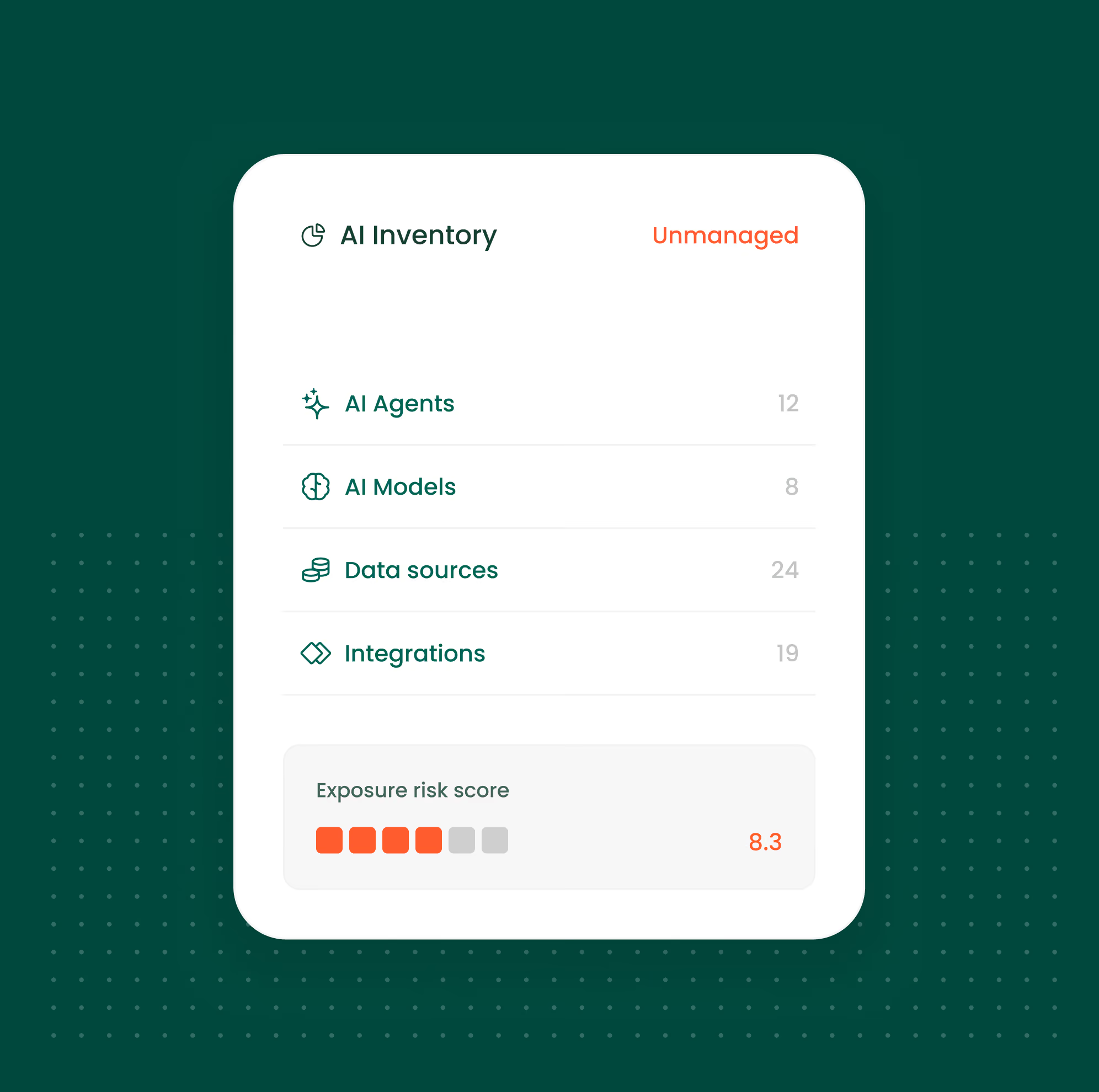
"My engineers are deploying AI agents I can't fully see. What can they actually reach?"
AI agents create new attack paths across code, data, and third-party services, but most teams can't map those relationships or understand the resulting risk.
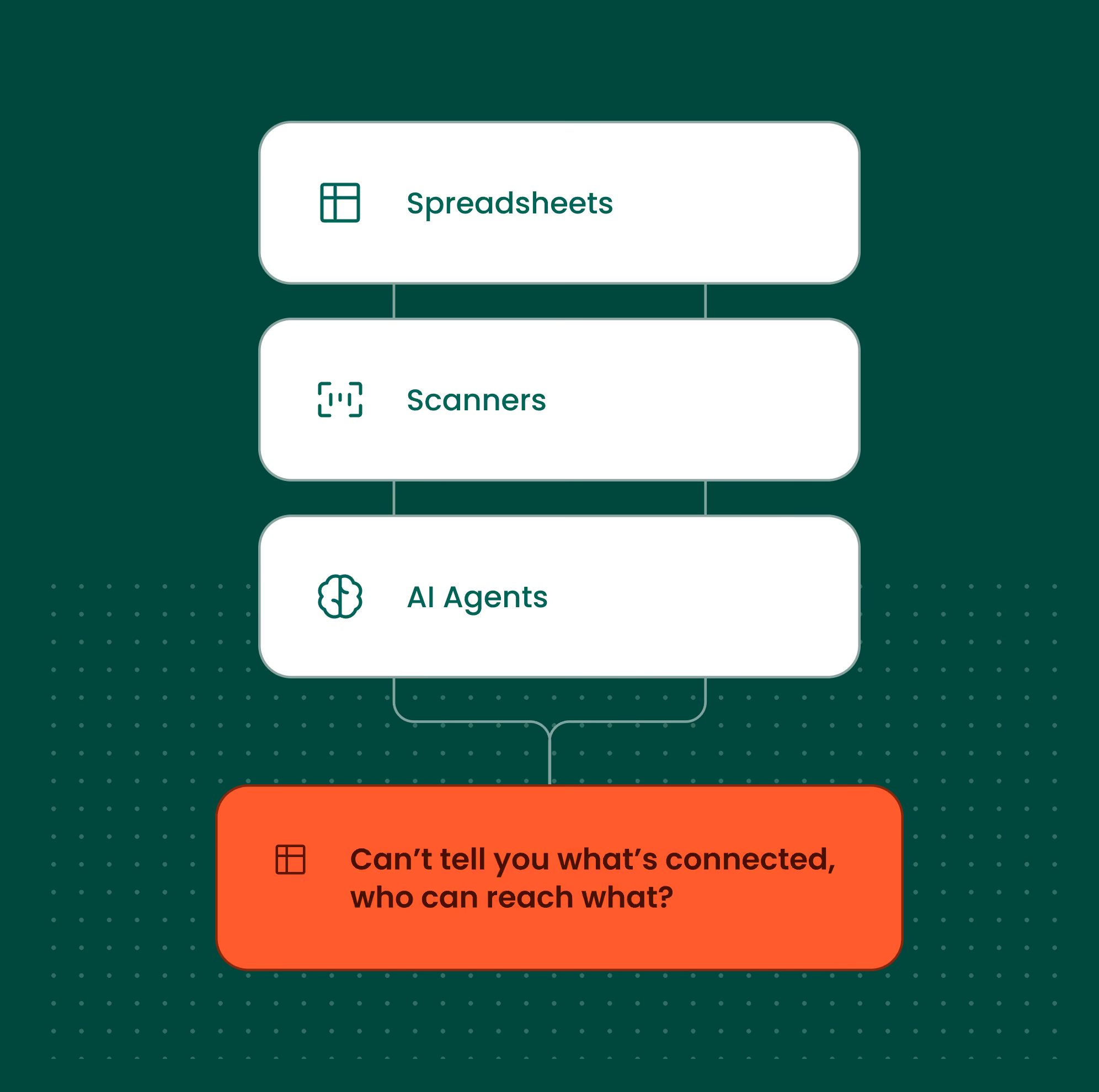
Why lists and logs fall short
Spreadsheets, CMDBs, and scanner reports store records, not relationships. They tell you what exists, but not what's connected, who has access, or what happens if a single asset is compromised.
AI doesn't solve that problem. Without a grounded data layer, it can only guess. That's how hidden attack paths and security incidents slip through.
What is a security graph?
A security graph is a graph-native data model that maps cyber assets, identities, and their relationships, allowing security teams to trace attack paths instead of searching disconnected records.
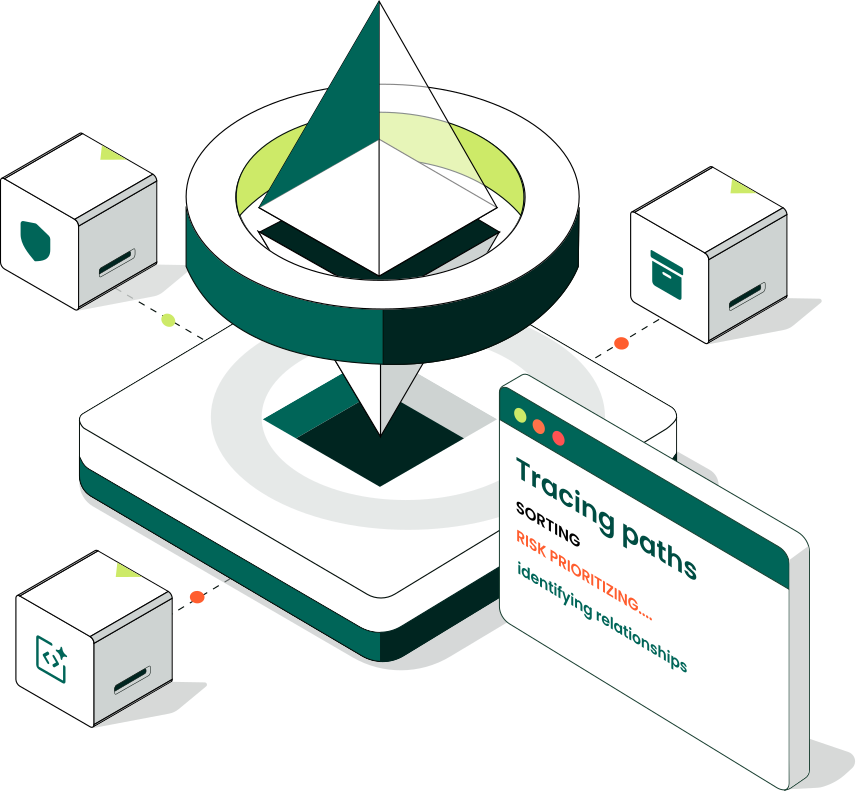
Rather than showing what exists, it reveals who can access what, which vulnerabilities are exposed, how AI agents interact with sensitive data, and the blast radius if any node is compromised.
Inside the Security Graph
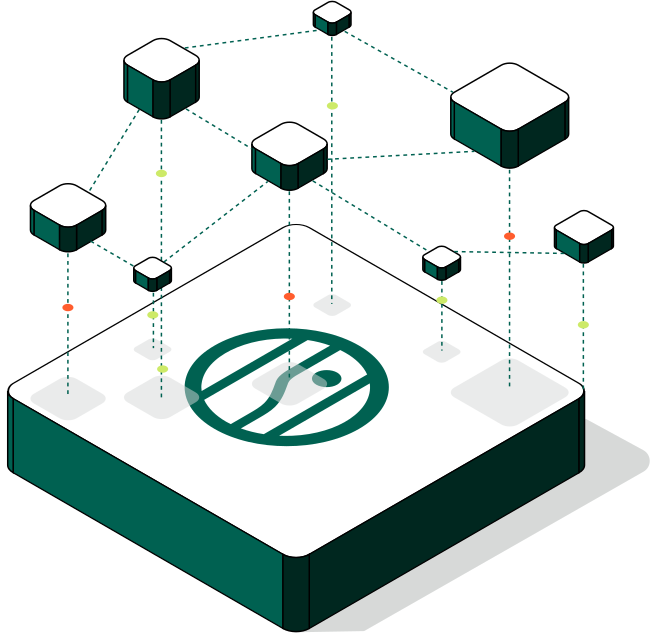
A security graph connects cyber assets, identities, and their relationships in one unified view, helping teams understand attack paths and blast radius.
Graph-native vs. graph-layered architecture
Many platforms only visualize relationships. Graph native databases store them directly, making real time attack path analysis fast and scalable.
What data lives inside the graph
Normalize data from 200+ integrations into one security graph, continuously mapping assets, identities, and relationships across your environment.
Is a security graph a knowledge graph?
Not quite. Security graphs focus on cyber assets and attack paths, while knowledge graphs model broad concepts for search and reasoning.
What does "AI data layer" mean in cybersecurity?
AI is only as trustworthy as the data beneath it. An AI data layer provides the structured security context needed for reliable answers and autonomous decisions.
Why AI models need grounded data to avoid hallucination
Ask AI a security question without a grounded data layer, and it will generate the most likely answer, not the correct one. Without trusted relationships behind every response, questions about exposure, exploitability, or AI agent access become educated guesses, creating false confidence where security teams need certainty.
.svg)
Natural language and J1QL: two ways to query the graph
Whether you ask a question in plain English or write it in J1QL, both query the same underlying security graph. That means AI responses and programmatic queries return the same deterministic, explainable answer, giving analysts the flexibility of natural language without sacrificing the precision and repeatability of structured queries.
How ontology-driven ingestion keeps the graph deterministic
JupiterOne's asset graph gives AI a grounded, deterministic data layer where every asset and relationship follows a consistent ontology. Instead of reasoning over disconnected telemetry, AI queries trusted graph data, producing explainable answers backed by real relationships across your environment rather than generated assumptions.
How the security graph works
The graph is built and kept current in four steps, and every JupiterOne product reads from the same pipeline.
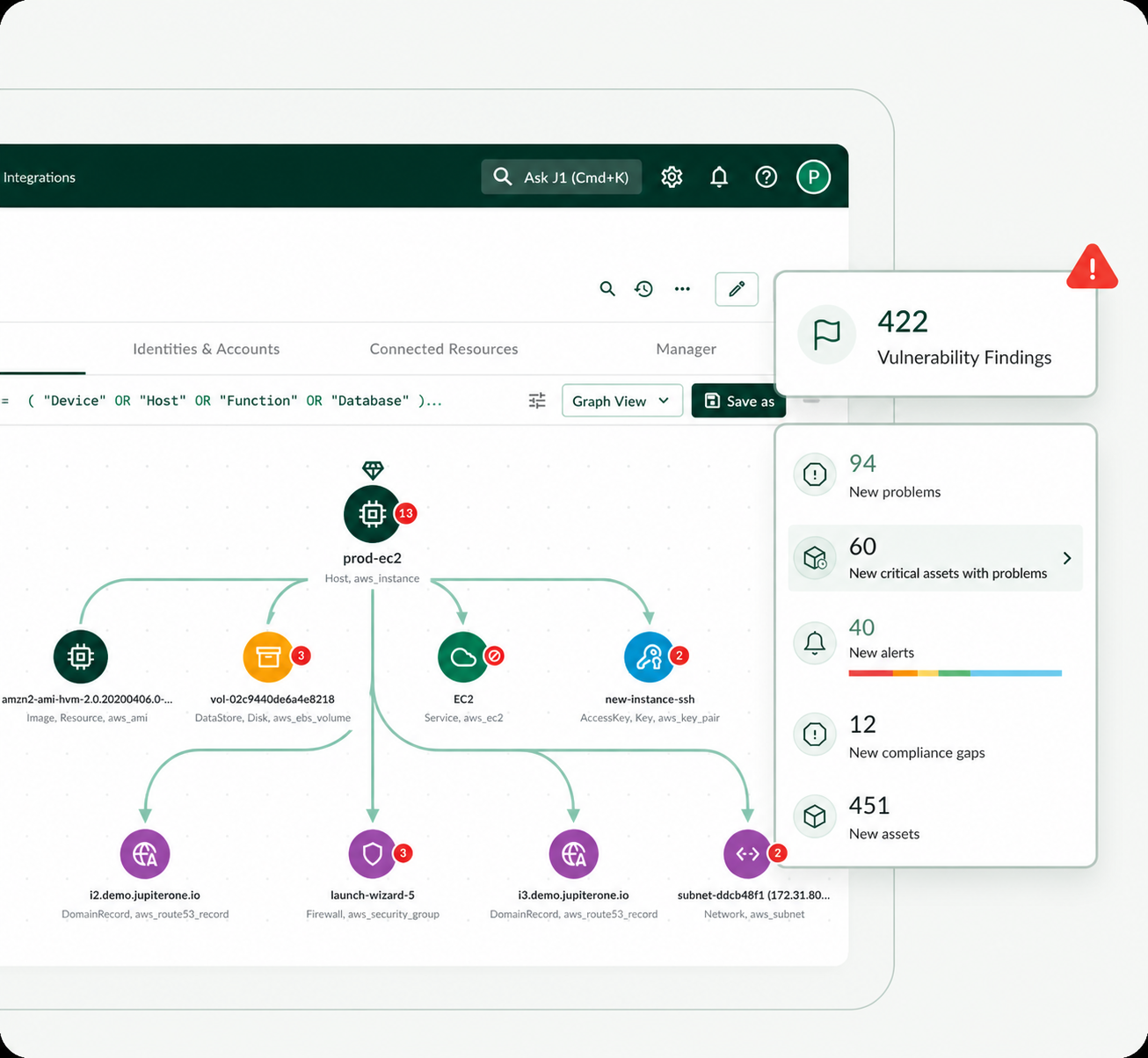
01.
Collect and normalize every asset
Agentless, API-driven ingestion from 200+ integrations spanning security, cloud, identity, DevOps, and HR tools — AWS, Azure, GCP, Okta, GitHub, Snowflake, Salesforce, and more — consolidated into a single, ontology-driven source of truth. AI models, copilots, and agents are ingested as first-class assets from day one, not appended later as an afterthought once someone asks where they went.
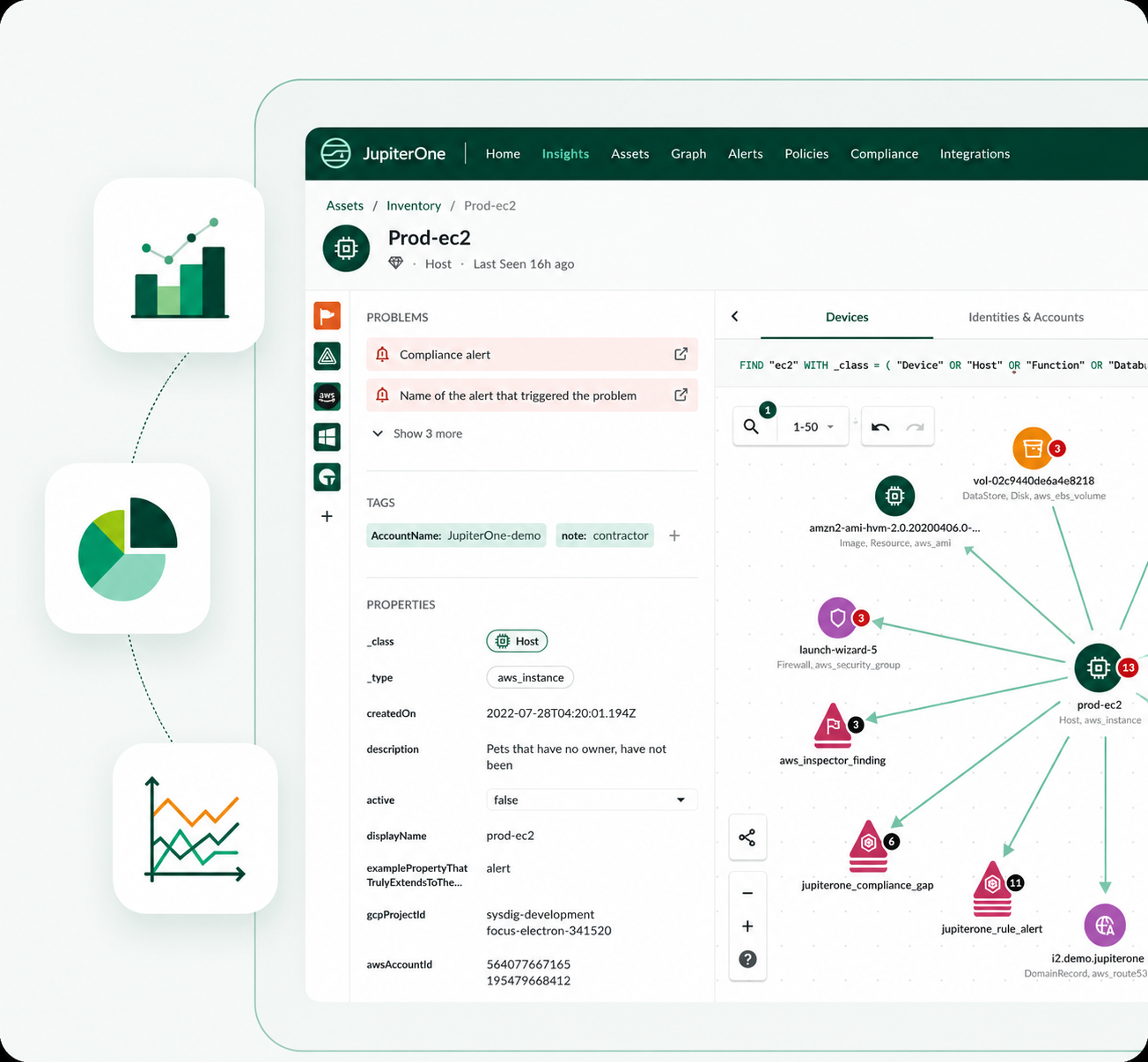
02.
Map relationships automatically
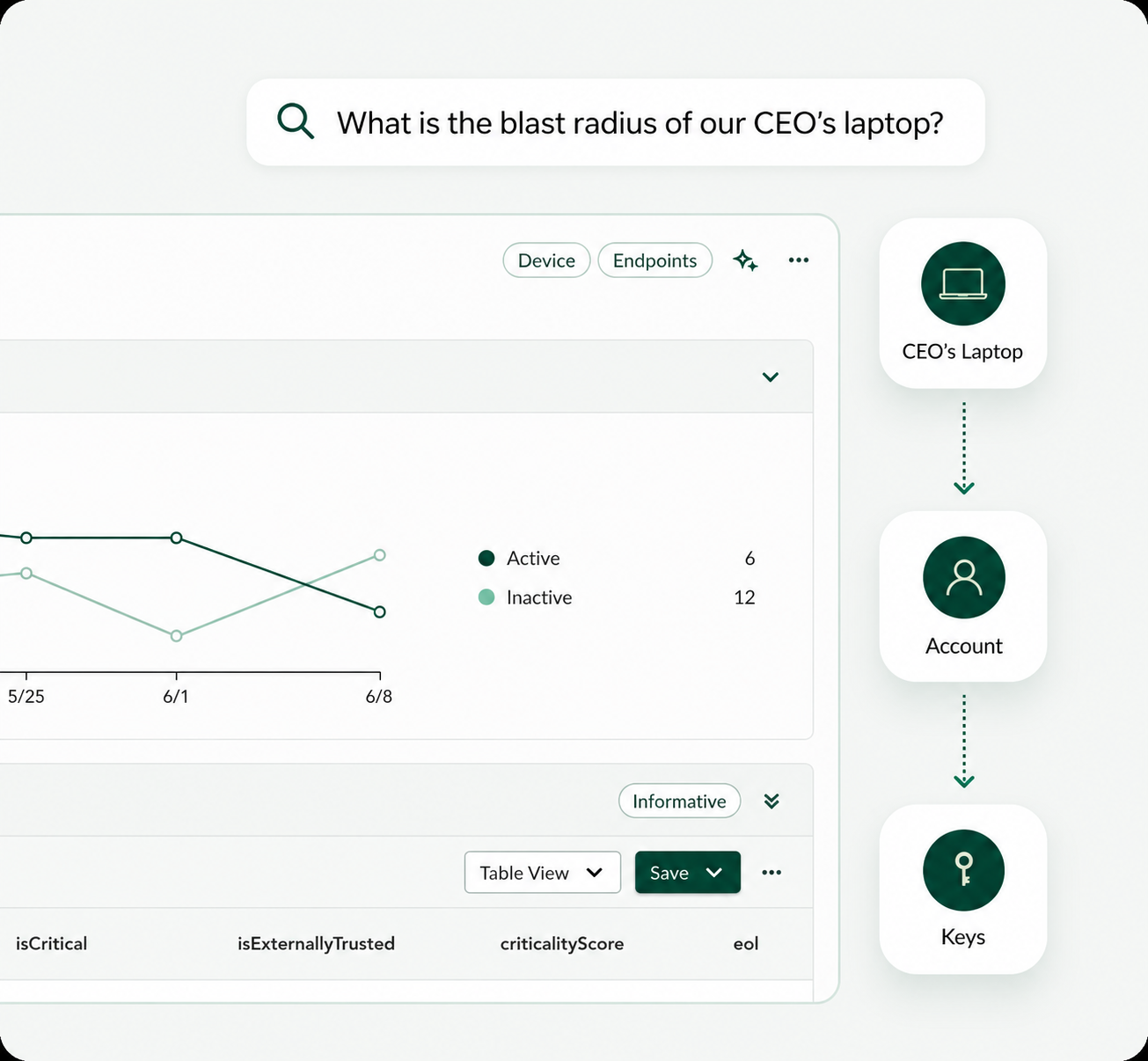
The graph reveals connections between assets, identities, vulnerabilities, and data that no spreadsheet or CMDB can surface on its own: toxic combinations, unmonitored shadow assets, and the full blast radius of any given exposure, mapped automatically as new data arrives instead of during a quarterly spreadsheet reconciliation.
03.
Query in natural language or J1QL
Ask a question in plain English through JupiterOne AI, or write a precise J1QL query for repeatable, programmatic analysis. Either path hits the same grounded data layer, so security engineers, architects, and analysts all get the same answer regardless of which interface they prefer to work in.
04.
Report, alert, and automate
Agentless, API-driven ingestion from 200+ integrations spanning security, cloud, identity, DevOps, and HR tools — AWS, Azure, GCP, Okta, GitHub, Snowflake, Salesforce, and more — consolidated into a single, ontology-driven source of truth. AI models, copilots, and agents are ingested as first-class assets from day one, not appended later as an afterthought once someone asks where they went.
Trusted by security teams who stopped chasing severity.
Every risk in context. One graph.
All JupiterOne products use one graph-native model, so every finding reflects your full environment—no silos or reconciliation needed.



Security graph vs. asset intelligence: what's the real difference?
"Asset intelligence" and CAASM tools promise visibility, and most of them deliver an inventory: a long, enriched list of what you own, tagged with metadata and telemetry pulled from your existing tools. That's a genuinely useful starting point, and it's the category JupiterOne came out of — but it's the floor for what a modern data layer needs to deliver, not the ceiling.
01.
What an inventory can't tell you
A list can tell you that an asset exists and who owns it. It generally can't tell you what that asset can reach, what would happen if it were compromised, or how it connects to five other assets across cloud, identity, and code. Those are relationship questions, and a flat inventory — however well-tagged with metadata and enriched with extra context — isn't built to answer them. Enrichment adds more fields to a record; it doesn't add the edges between records that a relationship question actually needs.
02.
Why relationship context matters for AI-driven decisions
A security graph goes a step further: it's built to answer relationship questions an inventory can't, including what an AI agent can actually touch. That relationship layer is also what separates a usable AI data layer from a database an LLM can query but not trust. If the underlying model is a list, the AI answering questions on top of it is only ever as good as the last manual correlation someone happened to run — and that correlation work is precisely what a graph-native architecture does automatically, continuously, instead of on a quarterly cadence.
Answers, in plain English.
These are the most common questions about scanners.
Can’t find what you’re looking for? Send us an e-mail
What counts as a cyber asset?
A cyber asset is any on-prem or cloud resource in your security and IT environment — devices, applications, data stores, code repositories, networks, security controls, users, configurations, and AI models or agents. All of them live as connected nodes in the graph, classified against the same ontology regardless of which of the 200+ integrations they arrived through.
How is a security graph different from a CMDB?
A CMDB stores configuration records as isolated entries, usually updated on whatever schedule someone remembers to run a sync. A security graph stores those same assets as connected nodes with typed relationships between them, updated continuously, so you can trace attack paths and blast radius instead of just looking up a record and hoping it's current.
Can I query the graph without learning J1QL?
Yes. JupiterOne AI lets you ask questions in natural language, so most day-to-day questions never require writing a query at all. Security engineers and architects who want precise, repeatable queries for recurring reports or automated triggers can still use J1QL, JupiterOne's proprietary query language — both draw from the same grounded graph, so the results always agree.
How does JupiterOne reduce AI hallucination risk?
By enforcing a strict ontology on data ingestion, so every asset and relationship in the graph is deterministic rather than inferred or reconstructed after the fact. AI models and natural-language queries reason over that grounded structure instead of raw, disconnected telemetry, which is what lets JupiterOne AI point to the specific relationship path behind an answer instead of asserting a conclusion with no way to check it.
See your environment as a
graph, not a spreadsheet
If AI can't trust your data, neither should you. JupiterOne's security graph gives every AI decision a grounded, relationship aware foundation.