Exposure Management: Stop Counting Vulnerabilities. Start Disrupting Attack Paths.
JupiterOne unifies exposure data from every source onto your security graph — aggregated, deduplicated, and prioritized by what’s actually exploitable in your environment. Then it goes further: validated mitigations, actively monitored controls, and the context your team (or your AI) needs to disrupt an attack path before the permanent fix ships.









Why Traditional Vulnerability Management Can’t Keep Pace with AI-Driven Attacks
The measure of a security program is changing. It’s no longer how many vulnerabilities you found — it’s how quickly you can disrupt an attack path and reduce real risk. AI-driven adversaries don’t file change requests or wait on patch windows. They find an exposure and move. The window between a vulnerability being disclosed and being weaponized keeps shrinking, while the average enterprise remediation cycle — triage, ticket, change approval, patch, verify — has barely moved in a decade.
Traditional vulnerability management was built for a different problem. Scanners enumerate CVEs and rank them by severity score, but CVSS doesn’t know your environment.
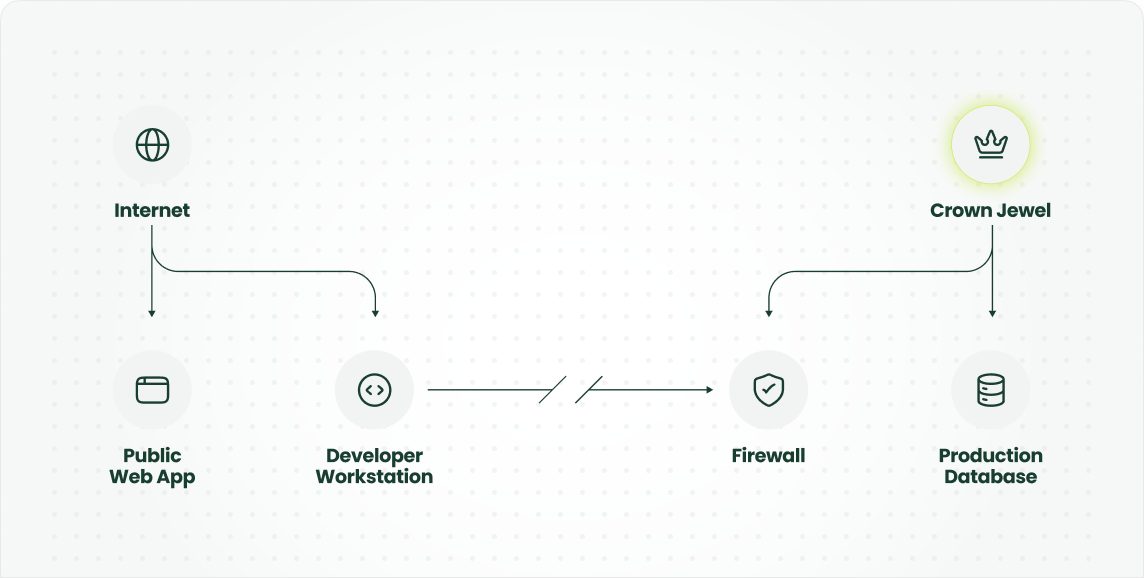
It doesn’t know that the “critical” finding sits on a sandboxed dev box while the “medium” runs on the internet-facing asset one hop from production data. It doesn’t know which identity can reach which workload, or which compensating control already takes the risk to zero. The result is a queue nobody can clear, SLAs nobody can hit, and security teams spending more time proving findings aren’t real problems than fixing the ones that are.
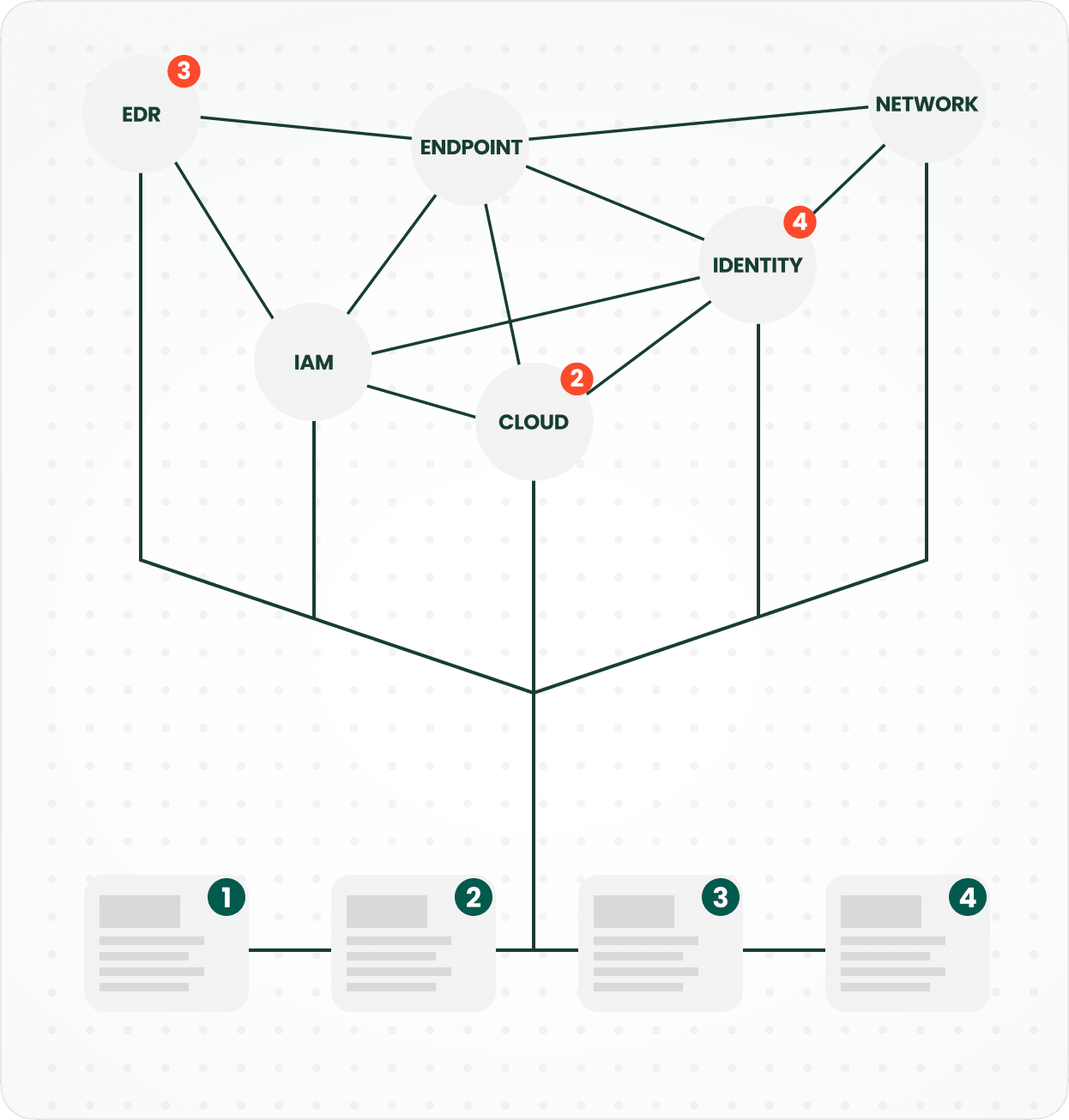
Fragmented point solutions widen the gap. Scanners, cloud security platforms, AppSec tools, and identity systems each produce their own findings, their own scores, and their own blind spots — siloed data, duplicated tickets, and conflicting priorities. Exposures fall between security domains and ownership boundaries. Response slows precisely when speed matters most.
Exposure management can’t work in disjointed silos. It needs one place where every asset, exposure, control, and relationship is connected. That place is the security graph.
Why Traditional Vulnerability Management Can’t Keep Pace with AI-Driven Attacks
What Is Exposure Management?
Exposure management is the continuous practice of discovering, prioritizing, validating, and remediating the exposures across your attack surface — vulnerabilities, misconfigurations, identity risks, and control gaps — based on real-world exploitability and business impact rather than raw severity scores. It shifts the goal of a security program from counting findings to measurably reducing risk.
Where vulnerability management asks “what is vulnerable?”, exposure management asks a harder and more useful question: “of everything that’s vulnerable, what can an attacker actually use and what’s the fastest way to take it away from them?” Answering that question requires context that no single scanner has: how assets connect to each other, which identities can reach them, what data they touch, which controls protect them, and whether those controls are actually working right now.
That’s why exposure management is an architectural problem before it’s a process problem. The organizations doing it well have one thing in common: a unified data layer where exposures, assets, identities, and controls live together and can be reasoned about as a whole. JupiterOne builds that layer as a security graph and runs the full exposure lifecycle on top of it.
What Counts as an Exposure?
An exposure is any condition in your environment that an attacker can use to gain access, escalate privileges, or move toward valuable assets. Software vulnerabilities are the most familiar category, but they’re a minority of what actually gets exploited. A complete exposure management program covers:
- Software vulnerabilities (CVEs) — in operating systems, applications, container images, and open-source dependencies, reported by scanners across cloud, code, endpoint, and network.
- Misconfigurations — public storage buckets, permissive security groups, disabled logging, default credentials, unencrypted data stores.
- Identity exposures — over-permissioned users and service accounts, stale contractor access, missing MFA, privilege escalation paths.
- Control gaps — assets missing required EDR coverage, failing or drifted security controls, broken policy enforcement.
- Exposed secrets and keys — credentials in code repos, tokens in CI/CD logs, unrotated API keys.
- Unknown and unmanaged assets — shadow IT, orphaned cloud resources, end-of-life systems that no scanner is even looking at.
Any one of these can anchor an attack path. Exposure management treats them as one problem with one queue because that’s how attackers treat them.
Exposure Management vs. Vulnerability Management: What’s the Difference?
Vulnerability management is a subset of exposure management. It focuses on finding and patching software vulnerabilities, usually ranked by severity. Exposure management broadens the scope to every exploitable condition, adds business and relationship context to prioritization, validates that mitigations actually hold, and measures success by risk reduced rather than findings closed.
The practical difference shows up in the queue. A vulnerability management program hands your team ten thousand findings ranked by CVSS. An exposure management program hands them a short list of validated, business-contextualized exposures — with a remediation plan that says exactly which fix removes the most risk for the least work. Neither replaces the other: your scanners remain essential sensors. Exposure management is the intelligence layer that makes their output actionable.
What Is Continuous Threat Exposure Management (CTEM)?
Continuous threat exposure management (CTEM) is a framework introduced by Gartner for continually evaluating and reducing cyber risk. Rather than a product category, CTEM is a program — an iterative cycle of five phases that organizations repeat continuously: scoping, discovery, prioritization, validation, and mobilization. Exposure management platforms exist to operationalize this cycle.
Phase 1 — Scoping the Attack Surface
Define what matters: business-critical systems, crown-jewel data, regulatory boundaries, and the parts of the attack surface in play for this cycle. Scoping aligns the program to business priorities so the phases that follow measure what leadership actually cares about.
Phase 2 — Discovery of Assets and Exposures
Inventory the assets in scope and the exposures on them — vulnerabilities, misconfigurations, identity risks, and control gaps — across cloud, code, endpoints, and identity systems. Discovery quality determines everything downstream: an exposure you can’t see is an exposure you can’t manage.
Phase 3 — Prioritization by Real Risk
Rank exposures by the risk they actually represent: threat severity and exploit likelihood, but also asset criticality, attack path context, reachability, and existing compensating controls. This is where fragmented tools fail hardest — context lives across silos, so prioritization defaults back to severity scores.
Phase 4 — Validation of Exploitability and Controls
Confirm which exposures are real and exploitable, and whether the controls you’re counting on actually work. Validation separates theoretical risk from genuine risk, and turns “we think we’re covered” into evidence.
Phase 5 — Mobilization of Remediation
Turn findings into action: route work to the right owners with the context they need, track it to closure, and report progress in business terms. Mobilization is where most programs stall — tickets without owners, fixes without verification, and reports without risk context.
What Is an Exposure Assessment Platform (EAP)?
An exposure assessment platform (EAP) is the technology backbone of the first three CTEM phases: it aggregates exposure data from your existing tools, normalizes and deduplicates it, enriches it with business context, and prioritizes what matters. EAPs evolved from vulnerability prioritization tools and cyber asset attack surface management (CAASM) platforms as the market recognized that assessment requires asset context, not just finding aggregation.
JupiterOne delivers the full EAP capability set — aggregation, deduplication, contextual prioritization — with a structural advantage: exposures land in a graph that already understands your assets, identities, controls, and their relationships. Assessment isn’t a separate data silo; it’s a view over the same connected model that powers asset management and controls monitoring.
What Is Exposure Validation?
Exposure validation is the practice of confirming whether an exposure can actually be exploited in your environment, and whether the controls meant to mitigate it actually work. It’s the difference between a prioritized guess and an evidence-backed decision. Validation technologies fall into two families:
Adversarial Exposure Validation (AEV)
AEV tools — breach and attack simulation, automated penetration testing, continuous automated red teaming — actively execute attack techniques to prove exploitability. They deliver high-confidence evidence but require careful scoping, since they run real attack behavior against production-adjacent systems.
Predictive Exposure Validation
Predictive validation evaluates the technical conditions for exploitation without executing attacks: attack path simulation, reachability analysis, and security controls assessment. JupiterOne’s validation is predictive — and continuous. Every mitigation can be linked to a control that is tested on an ongoing basis, so the validation isn’t a point-in-time exercise. If the control fails next Tuesday, you know next Tuesday.
The two approaches are complementary: predictive validation continuously across the whole estate, adversarial validation periodically for the highest-stakes paths. What matters is that validation happens at all — without it, exposure management collapses back into list management.
What Is Preemptive Security? From Remediation to Interdiction
Preemptive security is the shift from reacting to attacks toward removing the conditions that make them possible, acting on validated exposures before an adversary reaches them. The concept matters because of an uncomfortable arithmetic: the permanent fix for an exposure moves at the speed of change management, while exploitation moves at the speed of automation. Patching a fleet, updating application code, or re-architecting a service can take days or weeks even with strong automation, because responsible organizations test, stage, and approve changes. An AI-driven attacker does none of that.
Interdiction closes the gap. Instead of racing the attacker to the permanent fix, you disrupt the attack path itself: enable a compensating control on the vulnerable asset, tighten a rule one step upstream on the WAF or the network, or constrain the identity that makes the path traversable. The exposure still gets its permanent fix through normal change control — but the path an attacker needed is already severed, and the clock that matters (time to disruption) stopped days earlier.
This is where exposure management earns its budget. A program that only produces prioritized lists still leaves the window open while remediation grinds forward. A program that can validate which controls would break a path — and confirm they’re actually working — turns the same list into immediate risk reduction.
Why Unified Exposure Management Is Displacing Point Solutions
The exposure management market is consolidating rapidly. Enterprises that assembled CTEM programs from point solutions — a scanner here, a prioritization tool there, a validation product on the side — are discovering that the seams between tools are exactly where exposures hide. Every handoff between products means data loss, latency, and another console for the team to reconcile.
Unified exposure management resolves this by running the whole lifecycle on one data foundation: the same platform that discovers an exposure also prioritizes it against live asset context, validates the mitigation, and mobilizes the fix. Analyst research and a wave of vendor acquisitions both point the same direction — the market is moving decisively toward unified platforms, and fragmented point solutions are being displaced.
What JupiterOne’s Exposure Management Platform Delivers
Four capabilities, one graph — mapped deliberately to the CTEM lifecycle so the platform operationalizes the framework instead of just name-dropping it.
Unified Exposure Assessment Across the Full Attack Surface
Ingest findings from every tool you run — cloud, code, container, endpoint, identity. JupiterOne aggregates, normalizes, and deduplicates across sources, so the vulnerability your scanner sees on a load balancer and the one your AppSec tool sees in a code repo resolve to a single exposure with a single owner. Multiple technologies covering the same assets stop producing duplicate work, and your team plans against one exposure record set instead of five conflicting queues.
PROOF
Contextual Exposure Prioritization That Shows Its Work
No black-box risk scores. Multi-layered prioritization starts with threat severity — CVSS, EPSS, and a floor for anything on the CISA KEV list — then weights each exposure by asset context (is it a crown jewel, or on an attack path to one?), exposure context like internet reachability, and any compensating controls already reducing the risk. Every factor is visible, every weight is configurable per business, and the same CVE scores differently on two assets when their real risk differs. That’s prioritization your engineers can reason about and your auditors can read.
PROOF
Exposure Validation: Mitigations That Stay Honest
Mark an exposure as mitigated and link it to a continuously tested control — a host intrusion detection policy, an endpoint agent, a WAF rule. JupiterOne tests that control on an ongoing basis. If it ever fails or drifts — an engineer changes a deployment, a policy gets loosened, an agent stops reporting — the exposure automatically reopens in your backlog. No more accepted risks that quietly stopped being true six months ago. Your risk register becomes a living system instead of a spreadsheet of assumptions.
PROOF
Attack Path Disruption: Interdict First, Then Ship the Fix
Real remediation takes time — change windows, code updates, re-architecture. Attackers don’t wait. JupiterOne identifies the compensating control that breaks the attack path now, buying your team time to ship the permanent fix, then builds remediation plans around the minimum work that removes the most risk: patch one base image, bump one library, enable one control, and hundreds of related findings close in a single action. Tickets route to mapped owners in Jira or ServiceNow with assets, steps, and verification attached and close automatically when the graph confirms the risk is gone.
PROOF
How Does Exposure Management Work on the Security Graph?
Everything in JupiterOne — assets, identities, exposures, controls, owners — is a node in one continuously updated graph, connected by real relationships: this workload runs this image, is reachable from the internet, holds this data, is protected by this control, belongs to this team. The exposure lifecycle runs as four continuous steps over that graph.
01.
Discover — Every Exposure, Every Source, One Graph
Connect scanners, cloud accounts, code repos, and identity providers through 200+ integrations. Exposures stream into the security graph, deduplicate across sources, and attach to the assets they affect — which means every finding arrives already carrying its context: owner, environment, criticality, connections.
02.
Prioritize — Attack Paths and Business Context, Not Just Severity
Each exposure is scored by threat severity, asset criticality, attack path proximity to crown jewels, reachability, and actively monitored controls. The output is a short, defensible list — the exposures that genuinely put the business at risk today.
03.
Validate — Prove the Mitigation Holds
Mitigations link to continuously tested controls. Passing tests keep the exposure in its mitigated state with evidence attached; a failing test reopens it automatically. Validation runs on a schedule, not on an annual audit.
04.
Mobilize — Remediation Plans to the Right Owner
Remediation plans identify the smallest set of actions that removes the most risk, split work by mapped asset owner, open the tickets with full context, and track everything back to closure — with SLA and MTTR reporting by owner and organizational unit for leadership.
Exposure Management for Every Role on the Security Team
Exposure management is a team sport — the CISO defends the numbers, the architect owns the data model, analysts work the queue, and vulnerability management leads run the program. The platform has to serve all four without forcing any of them into someone else’s workflow. Here’s how JupiterOne shows up in each role’s day.

01.
Report risk burn-down, not ticket counts.
Exposure SLAs and MTTR by owner and business unit, with every prioritization decision explainable to the board, the regulator, and the auditor. Know the answer to “are we exposed?” before you’re asked.

02.
One graph for exposures, assets, identities, & controls.
Integrations across your scanners, cloud, ticketing, and control platforms. Scoring logic expressed in J1QL — inspect it, tune it, prove it. No black boxes anywhere in the pipeline.

03.
Work the short list that actually reduces risk.
Findings deduplicate across every source and collapse into remediation plans — the minimum work that removes the most risk. Fix the image once, close hundreds of findings.

04.
From backlog management to attack path disruption.
Mark an exposure mitigated and link it to a continuously tested control. If the control fails, the exposure reopens automatically. Your accepted-risk register finally polices itself.
How Does JupiterOne Compare to Other Exposure Management Tools?
Most platforms aggregate and score. JupiterOne validates and disrupts.
Aggregation is table stakes — any exposure assessment platform can consolidate findings into one dashboard. The gaps show up further down the lifecycle. Aggregators can’t see asset relationships, so prioritization falls back to severity plus threat intel. They can’t test controls, so “mitigated” means someone clicked a status. And they stop at ticket creation, so mobilization is a Jira export. JupiterOne runs the full lifecycle on the security graph: relationship-aware prioritization, continuously validated mitigations, and remediation plans engineered to disrupt attack paths.
Which Exposure Management Metrics Actually Matter?
Vulnerability counts are a vanity metric. A program can scan more, find more, and patch more every quarter while actual risk stays flat because the findings being closed were never the ones an attacker would use. Exposure management replaces volume metrics with velocity and validation metrics:
Time from discovery to attack path disruption — the headline metric. How long does an exploitable path to critical assets stay open? Interdiction (a compensating control that breaks the path) stops this clock; the permanent fix can follow at change-management speed.
Mean time to remediate (MTTR), segmented by owner and criticality — averages hide failure. MTTR on crown-jewel-adjacent exposures is the number that belongs in front of the board.
SLA attainment by organizational unit — which teams are keeping up, which are drowning, and where the program needs capacity instead of blame.
Percentage of mitigations validated by live controls — how much of your accepted-risk register is backed by a currently passing control test versus a status field someone set last year.
Deduplication ratio — raw findings versus unique exposures. A 10:1 ratio means your team was doing ten times the triage the risk required.
Remediation efficiency — findings closed per remediation action. Fix-once-close-many plans drive this up; ticket-per-finding programs keep it at 1.
Exposure backlog age on prioritized items — old criticals are the honest indicator of whether prioritization is trusted by the teams doing the work.
Every one of these is queryable in JupiterOne and reportable by owner, business unit, and framework — because the graph already knows who owns what and what matters.
How to Evaluate an Exposure Management Platform
Whether you’re consolidating point solutions or building a CTEM program from scratch, the same eight questions separate platforms that manage exposure from platforms that manage lists:
Does it cover the full attack surface?
Cloud, code, endpoints, identity, SaaS — not just cloud workloads. Ask specifically about identity exposures and control gaps, the categories scanners miss.
01
Does it deduplicate across sources, or just aggregate?
Ask to see the same CVE reported by two tools on one asset. One exposure or two tickets?
02
Can it explain every prioritization decision?
Black-box risk scores fail the first audit and the first argument with an engineering team. Insist on visible factors and tunable weights.
03
Does prioritization understand relationships?
The same vulnerability on an isolated dev box and on an attack path to production data should score differently. If the platform can’t show you the path, it can’t make the distinction.
04
How does it validate mitigations?
“Mark as mitigated” is a status field. Ask whether mitigation claims are linked to controls that are tested continuously — and what happens when a control fails.
05
Can your AI use it?
Bi-directional APIs, natural language querying, and explainable answers. If you’re building agentic workflows, the exposure platform is either their data layer or their blind spot.
06
Does mobilization go beyond ticket creation?
Owner mapping, remediation plans grouped by root cause, automatic closure verification, SLA reporting by team.
07
Does it consolidate tools or add one more?
The right platform should absorb the work of a vulnerability prioritization tool, an aggregator, and a reporting layer — not sit beside them.
08
JupiterOne was built to answer all eight — and the fastest way to pressure-test that claim is a demo against your own environment.
Security Teams That Measure Risk Reduction, Not Findings
7
Minutes
2M+
vulnerabilities
24x
a day

Will Gregorian | Operator-first IT & Security
Galileo Medical
Answers, in plain English.
These are the most common questions about exposure management.
Can’t find what you’re looking for?
Send us an e-mail
What is exposure management in cybersecurity?
Exposure management is the continuous practice of discovering, prioritizing, validating, and remediating exploitable conditions — vulnerabilities, misconfigurations, identity risks, and control gaps — across your attack surface, ranked by real-world exploitability and business impact. It operationalizes Gartner’s continuous threat exposure management (CTEM) framework and shifts the goal from counting findings to measurably reducing risk.
What is the difference between exposure management and vulnerability management?
Vulnerability management finds and patches software vulnerabilities, usually ranked by severity score. Exposure management covers every exploitable condition — not just CVEs — prioritizes by business context and attack paths, validates that mitigations actually hold, and measures success by risk reduction. Vulnerability management is a component; exposure management is the program around it.
What is CTEM and how does JupiterOne support it?
Continuous threat exposure management (CTEM) is Gartner’s five-phase framework for continuously reducing cyber risk: scoping, discovery, prioritization, validation, and mobilization. JupiterOne operationalizes all five on one security graph — discovery through 200+ integrations, relationship-aware prioritization, validation through continuously tested controls, and mobilization through owner-mapped remediation plans.
What is an exposure assessment platform (EAP)?
An exposure assessment platform aggregates exposure findings from your existing tools, deduplicates and normalizes them, enriches them with business context, and prioritizes what matters. JupiterOne delivers full EAP capabilities with a structural difference: exposures land in a security graph that already understands your assets, identities, and controls — so context is native, not bolted on.
Does JupiterOne replace our vulnerability scanners?
No. JupiterOne sits on top of the scanners and security tools you already run and makes their output actionable. Bring your own scanners; we unify, contextualize, validate, and mobilize what they find. Most customers keep their existing scan coverage and retire standalone aggregation and prioritization tools.
How does exposure prioritization work in JupiterOne?
Each exposure is scored in transparent layers: threat severity (CVSS, EPSS, with a floor for CISA KEV entries), asset context such as crown-jewel status and attack path proximity, exposure context such as internet reachability, and risk reduction from actively monitored compensating controls. Every factor is visible and every weight is configurable — no black-box scores.
What is a compensating control and how does JupiterOne validate them?
A compensating control reduces the risk of an exposure without removing it — an intrusion detection policy, a WAF rule, an endpoint agent. JupiterOne links mitigated exposures to controls that are tested continuously. While the control passes, the exposure stays mitigated with evidence attached. If it fails or drifts, the exposure automatically reopens in your backlog.
What is attack path disruption?
Attack path disruption means breaking the chain an attacker would follow — from initial exposure to critical asset — before the permanent fix ships. Because remediation is often slower than exploitation, JupiterOne identifies where a compensating control can sever the path immediately, buying time for patching, code changes, or re-architecture to follow through normal change management.
How is exposure management different from CAASM?
Cyber asset attack surface management (CAASM) builds the continuously updated asset inventory and relationship map — the foundation. Exposure management runs on top of it: assessing, prioritizing, validating, and remediating the exposures on those assets. In JupiterOne they share one security graph, which is why exposure findings arrive with asset context already attached.
Can our AI agents and agentic workflows use JupiterOne?
Yes, your agents query JupiterOne as the source of truth for exposures, affected assets, controls, and remediation plans, then act through your own tooling. Every answer is explainable and traces back to inspectable graph relationships.
Can we trust the scoring — and the AI?
Every prioritization decision is transparent and configurable: you can see exactly why an exposure ranks where it does, tune the weights to your business, and trace any AI-generated answer back to the underlying graph data. Explainability isn't a feature request; it's the architecture.
What is unified exposure management?
Unified exposure management runs the entire CTEM lifecycle — discovery, prioritization, validation, and mobilization — on one platform and one data foundation, instead of stitching together separate point solutions for each phase. The unified approach eliminates the data loss, latency, and blind spots that occur at every handoff between tools, and it's the direction the exposure management market is consolidating toward.
How does exposure management support compliance and audit readiness?
Directly. Because JupiterOne's exposure management shares a graph with continuous controls monitoring, every prioritization and deprioritization decision carries evidence an auditor can read: the scoring factors, the compensating control, and the test results proving it works. Risk acceptance stops being a spreadsheet entry and becomes a control-linked, continuously validated record — which is exactly what frameworks like SOC 2, ISO 27001, PCI DSS, and DORA increasingly expect.
Who should own exposure management in the organization?
Typically the vulnerability management or security operations function owns the program day to day, with the CISO accountable for the risk outcomes it reports. But ownership of individual fixes belongs to the teams that own the assets — which is why owner mapping and mobilization matter as much as prioritization. JupiterOne routes each remediation plan to the mapped asset owner automatically, so the security team orchestrates the program instead of brokering every ticket.
How long does it take to see value?
Most teams connect their first scanners and cloud accounts in hours and see a deduplicated, prioritized exposure queue within days. The first "fix once, close many" remediation plan typically lands in the first two weeks — and the first control-linked mitigation turns the risk register into a living system from day one.
The Exposure Management Market Is Consolidating. Your Exposures Shouldn’t Wait.
Fragmented point solutions are being displaced by unified exposure management. See how fast your team could move from discovery to disruption on one security graph.