The Top 10 CTEM Vendors in 2026
Before Anthropic unveiled Mythos, Gartner predicted that by 2026, organizations prioritizing their security investments based on a CTEM program would suffer two-thirds fewer breaches. Mythos proved why. By discovering thousands of zero-days autonomously, Mythos didn't break traditional vulnerability management—it exposed how broken it already was.
The average time to remediate a software vulnerability climbed from 171 days in 2020 to 252 days in 2025, while mean time to exploit fell from 2.3 years in 2018 to roughly nine hours in 2026, according to data in JupiterOne's look at The Vulnerability Management Industrial Complex. With this math, traditional vulnerability management using a quarterly vulnerability scanning leaves blind spots between every run that cyber threats can take advantage of in hours.
Continuous threat exposure management (CTEM) replaces that cadence with a repeating cycle of scoping, discovery, prioritization, validation, and mobilization. Rather than working from the snapshot of periodic assessments, security teams have access to a real time view of their threat exposure. Security controls are marketed to help you with risk reduction by mapping attack paths, but not all are created equal. In this article, we map out the top 10 CTEM vendors and explain why each should be on your shortlist.
What are the Five Stages of CTEM?
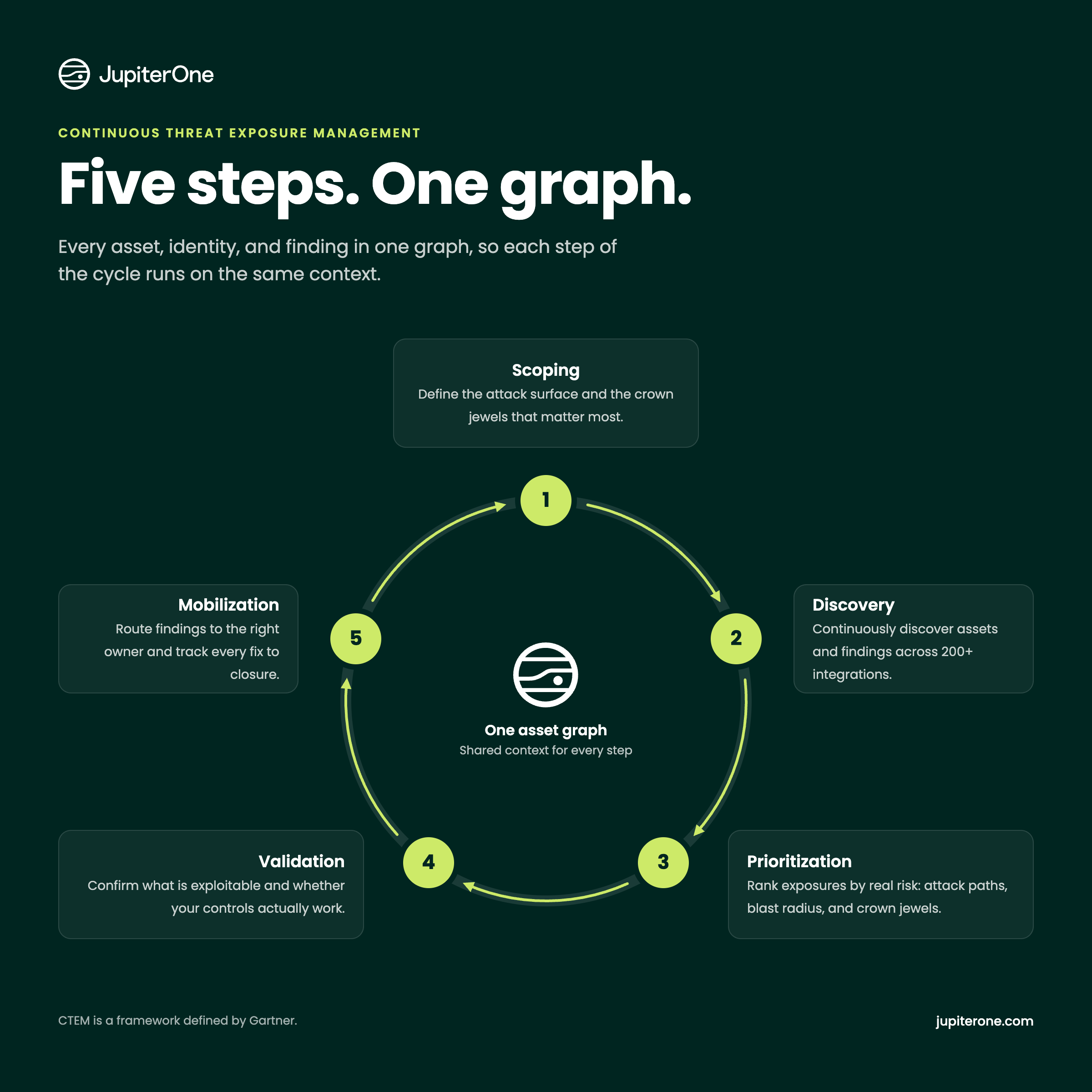
According to Continuous Threat Exposure Management (CTEM): A Definitive Guide, the CTEM lifecycle has five stages. A CTEM solution should support every one of them, and it's what we used as a standard for the vendors below.
Many products cover one or two stages well. A scanner handles discovery, and an attack simulation tool handles validation, but neither routes the fix to an owner. Each gap is a place where the cycle breaks and exposures sit unresolved. As you read the vendor entries in, consider how each handles the five stages, whether natively or through integrations, and where it hands the work to another tool.
1. Scoping
Scoping decides what the program protects and how success gets measured. It begins with the crown jewels, such as the customer database or the production billing system. The scope then extends to the full attack surface, including on-premises, hybrid, and cloud environments, with goals tied to outcomes like paths to critical assets closed.
2. Discovery
Discovery maps every asset and the exposures attached to it, across cloud, identity, endpoints, and code. It depends on reconciling many data sources into one record per asset and tying each finding to business context. The result is a queryable inventory that includes relationships, which shows the attack paths running through each asset.
3. Prioritization
Most environments produce more exposures than any team can fix, and CVSS alone does not narrow the list. Strong prioritization weighs reachability, exploitability, asset criticality, threat intelligence, and existing controls. It produces a short list that security teams can defend to a board, based on what an attacker could reach.
4. Validation
Exposure validation tests whether a prioritized findings holds up in a specific environment. Attack simulation and penetration testing show whether an attacker can exploit it, and continuous controls monitoring confirms that defenses work every day. Evidence takes the place of assumptions about risk.
5. Mobilization
A prioritized list only works when someone owns the fix. In this stage, each exposure goes to the right owner in the system that person already uses, with the attack path and an SLA attached. Once the fix ships, the path gets re-checked, and progress shows up as paths closed rather than tickets closed.
Top CTEM Vendors to Consider
1. JupiterOne
JupiterOne runs exposure management on a security graph instead of a findings list. Every exposure maps to the asset it lives on, what that asset connects to, and what is reachable from it. A vulnerability on an internet-facing host with an overpermissioned role leading to a customer database outranks a higher CVSS score on an isolated server.
JupiterOne reports a typical 1,000:1 compression from raw findings to prioritized exposures, and a 75% reduction in remediation plan size when teams prioritize by asset relationship instead of CVSS alone. Agentless integrations pull data from 200+ sources into one graph. J1QL queries span cloud, identity, code, and endpoints, and JupiterOne AI answers plain-English questions. Native ServiceNow and Jira integrations turn a query into an assigned, tracked ticket. Continuous Controls Monitoring runs on the same graph, so a fix updates your security posture without a second tool.
JupiterOne does not run simulated attacks itself. It supplies the attack path and asset context that validation tools lack, so teams that want exploit testing pair it with a dedicated attack simulation product.
Best for: security teams running 100+ cloud accounts or hybrid environments that already own scanners, EDR, or CSPM tools but have no unified view.
2. Tenable
Tenable One spans traditional IT, identity, cloud, OT, and container environments. It draws on multiple threat intelligence sources, CVSS v4.0, and EPSS to judge exploit likelihood, and it adds attack path analysis. Buyers should know that prioritization models cannot be customized and native remediation playbooks are limited. Tenable is available as SaaS or on-premises.
Best for: large enterprises growing from vulnerability management into exposure management.
3. Rapid7
Rapid7's Exposure Command platform ships with out-of-the-box remediation workflows, prebuilt integrations, and playbooks that assign and track fixes across common IT and ticketing systems. Its Noetic Cyber acquisition added automated asset discovery. The gap sits on the validation side, since third-party testing tool integrations are thin, though Rapid7 offers continuous red teaming as a managed service.
Best for: teams that want remediation automation built into the platform.
4. Qualys
The Qualys TruRisk platform services as the foundation of Risk Operations Center (ROC) and includes VMDR, CSAM, and Policy Audit. Through third-party integrations, Qualys is expanding its exposure assessment. Its compliance reporting is among the deepest in the category, covering PCI DSS, HIPAA, and ISO 27001. Attack path modeling reaches a limited set of assets. Qualys is SaaS with optional on-premises deployment.
Best for: regulated organizations that need vulnerability management and audit reporting from one vendor.
5. CrowdStrike
Falcon Exposure Management sits on the Falcon platform and covers EDR, CAASM, external attack surface management, and cloud posture natively. It maps threat intelligence to MITRE ATT&CK and offers many prebuilt remediation workflows with ServiceNow and Jira. It is SaaS only, and customers cannot build custom exposure scoring models.
Best for: organizations already standardized on Falcon.
6. Microsoft Security Exposure Management
Microsoft's offering lives inside the Defender ecosystem and combines agentless and agent-based discovery with graph-based attack path views. Reporting adapts to technical and executive audiences, and AI guidance supports multiple languages. It arrives bundled with Microsoft Security licenses rather than as a stand-alone product, and it runs as SaaS only.
Best for: Microsoft-centric organizations already licensed for Defender.
7. Armis (now part of ServiceNow)
Armis Centrix covers OT, IoT, and medical devices alongside IT. It includes native CAASM and automated security control assessment, holds FedRAMP Moderate authorization, and lets users customize prioritization algorithms. Native remediation orchestration is less mature, so some teams rely on third-party tools to close the loop.
Best for: healthcare and industrial environments with many unmanaged devices.
8. Nucleus Security
Nucleus aggregates findings from scanners and integrates natively with CAASM, EDR, CNAPP, and ASPM platforms. Customizable remediation workflows include SLA tracking and exception handling. Data-separated multitenancy suits service providers, and a FedRAMP-authorized deployment suits public sector buyers. It does not perform remediation actions inside the platform.
Best for: public sector teams and managed security service providers.
9. Balbix (now part of SAFE)
Balbix builds a cyber risk graph that maps assets, users, vulnerabilities, and threats to business impact. Scenario modeling and executive dashboards support risk conversations with leadership. Its scoring depends on clean input data, pricing runs above average, and bidirectional integrations are still maturing.
Best for: teams that report cyber risk to executives in financial terms.
10. Axonious
Axonius builds exposure management on a CAASM foundation. It normalizes asset data from across existing security and IT tools into one inventory, then uses that view to find the coverage gaps and misconfigurations that raise risk. Its integration breadth makes it easy to connect to the tools a team already runs. Dedicated exposure assessment capabilities arrived in 2025, so its prioritization and remediation depth is newer than its asset management core.
Best for: security teams that want to fix asset visibility and coverage gaps first, then grow into exposure management.
How Should You Choose a CTEM Tool?
Security leaders should start with the question they can't answer today. If it is "which of these ten thousand findings should we fix first?" – prioritization and attack path context come first. If it is "do our defenses stop real attacks?" – look at attack simulation and validation depth.
Then ask each vendor to run a query against your own data, not a slide. Which exposures can reach your most sensitive data? Does closing one update your compliance posture automatically?
For a closer look at the shift behind these questions, read JupiterOne's piece on exposure-based vulnerability management, learn more about JupiterOne's exposure management platform, or get a demo and see your exposures mapped instead of listed.
Frequently Asked Questions
What is continuous threat exposure management?
Continuous threat exposure management is a repeating program that discovers assets, prioritizes exposures by real risk, validates what an attacker could exploit, and mobilizes teams to fix it. It replaces point-in-time scans with an ongoing cycle.
How does CTEM differ from vulnerability management?
Vulnerability management finds and patches known CVEs. CTEM adds asset context, attack paths, and validation, and it covers misconfigurations and identity exposures that scanners miss.
How is CTEM different from traditional exposure management solutions?
Traditional exposure management works at a point in time. A team runs an assessment, produces a report, and repeats the process next quarter, so the findings age the moment the environment changes. CTEM runs as a continuous cycle. Asset data and exposure context refresh in real time, paths get re-checked after each fix, and controls are validated every day.
Do I need an attack simulation tool for CTEM?
Not always. Attack simulation proves whether an exposure is exploitable and whether controls respond. Teams often start with prioritization and attack path analysis, then add attack simulation as the program matures.
How does threat intelligence improve prioritization?
Threat intelligence shows which vulnerabilities attackers are exploiting now. Combined with asset criticality and reachability, it separates a theoretical risk from one that needs action this week.
Which CTEM tool works best for hybrid environments?
Look for security tools with agentless discovery, on-premises or sensor options, and one view across cloud and data center assets. Ask each vendor to demonstrate coverage of your actual environment.