Announcing Emerging Threats: Know Which Threats Changed Today
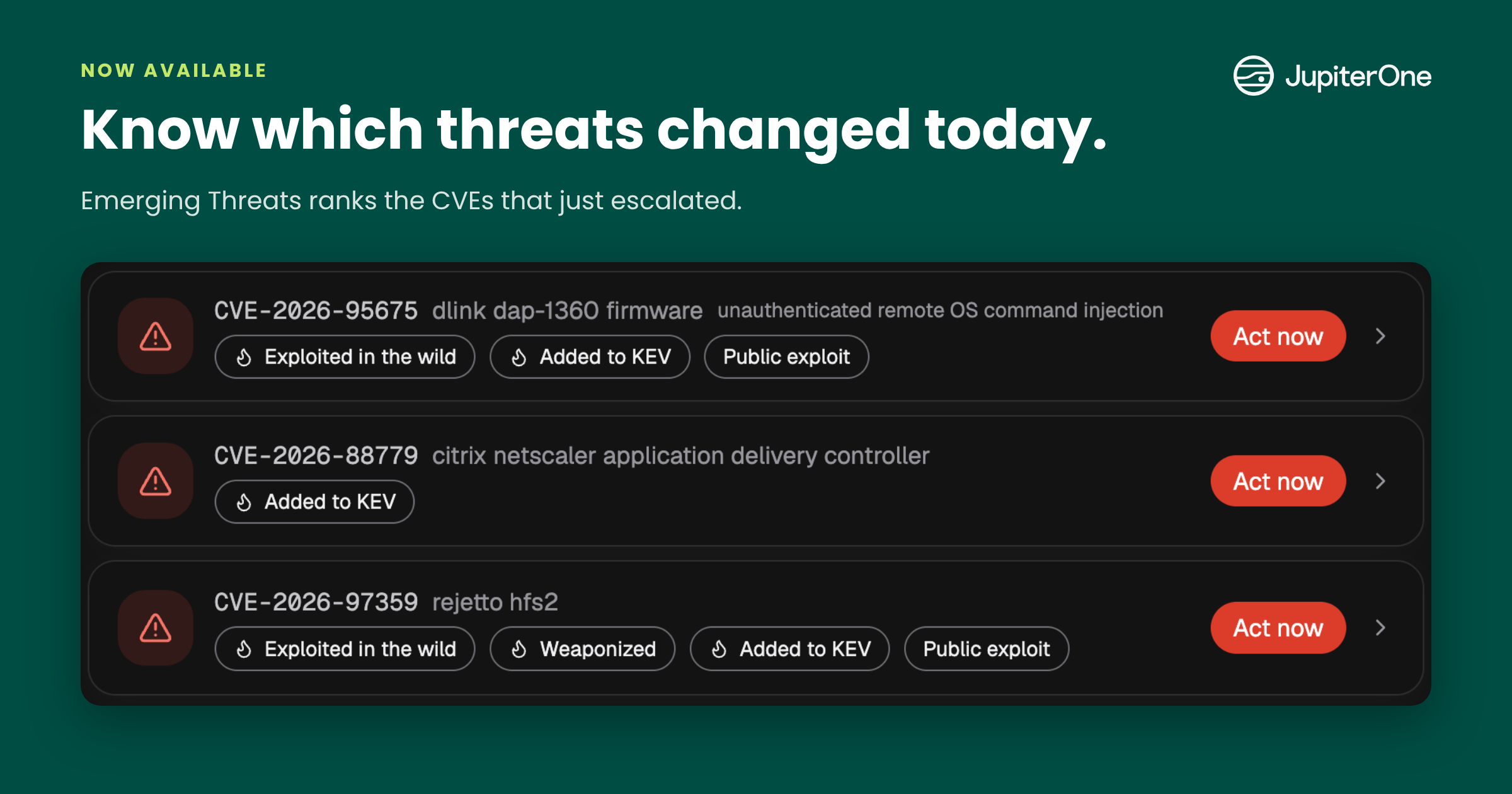
Every week brings a new batch of vulnerabilities and the hard part isn't finding them. It's knowing which ones changed enough to deserve your team's attention today. Emerging Threats, now available to every JupiterOne customer, answers that question. It surfaces up to ten trending CVEs, ranked by how recently they escalated and how dangerous they are, so your team starts the day with a short, defensible list instead of a feed of everything.
Severity alone doesn't tell you what to do today
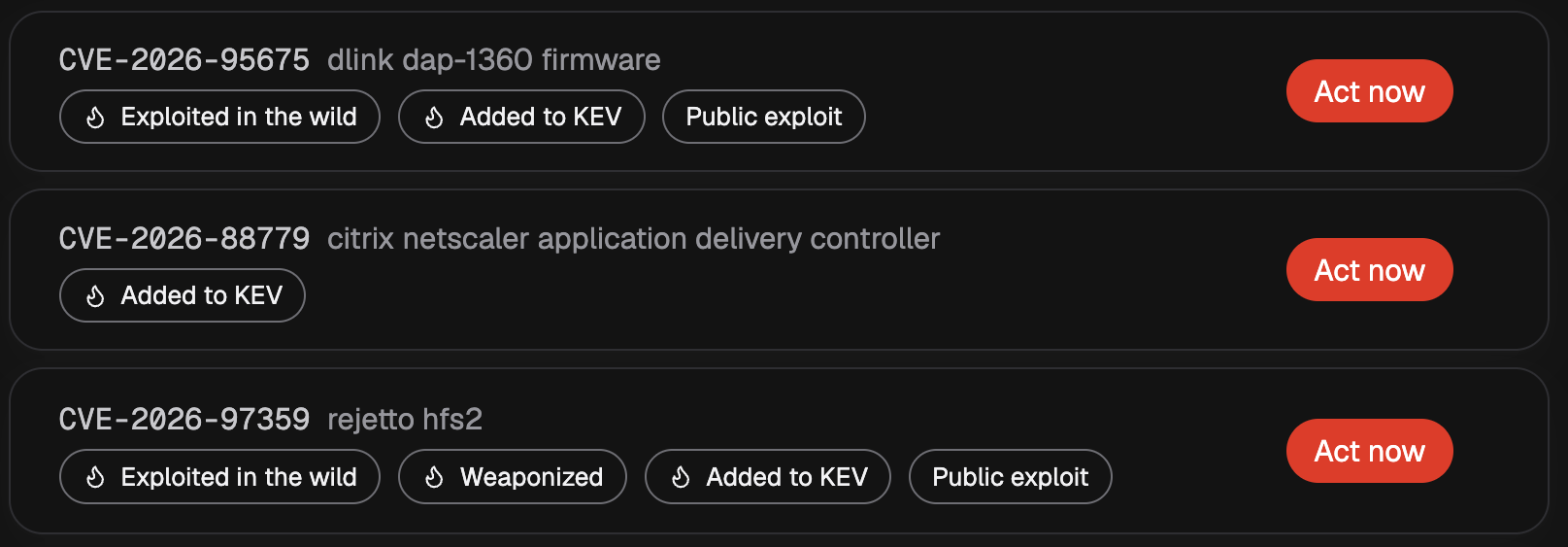
A CVSS score tells you how bad a vulnerability could be. It doesn't tell you whether something just changed and that's what decides what your team does first. Without that signal, analysts end up sorting through disclosures, exploit chatter, and scanner updates by hand. Emerging Threats does the sorting by ranking on transitions rather than state. A CVE surfaces when it recently crossed an escalation threshold: public exploit code appeared, a reliable weaponized exploit emerged, real-world exploitation was confirmed, or it was added to CISA's or VulnCheck's Known Exploited Vulnerabilities catalogs. Long-established CVEs drop off and older ones with fresh exploitation activity come back.
What it gives your team
- Know what to act on first. Every CVE carries a tier (Act now, Elevated, Monitor, or Low), the affected vendor and product, and a plain explanation of why it ranked where it did.
- Get the full picture in one place. Open a Threat Brief from the list, or search any CVE by ID. It brings together CVSS, EPSS percentile, exploit maturity, and KEV status with remediation guidance, an exploitation timeline, who is exploiting it, fix and mitigation references, and detection guidance, so no one has to assemble it from five sources.
- See where your scanners can't. If no commercial scanner ships a check for a CVE, we flag it. A clean scan isn't evidence of absence when no check exists.
- Trust the answer. Every brief shows when it was assessed and which sources it drew on. Anything that can't be scored says "Not scored" instead of being estimated.
From the threat to your environment
Emerging Threats reports on the CVE itself, drawing on public and commercial threat intelligence. It isn't scoped to your environment and that's deliberate: it tells you whether a CVE deserves a response. Unified Vulnerability and Exposure Management then shows which of your assets are affected, so the two steps run together: decide what matters, then see where it lands. The list is a periodically refreshed snapshot with an "as of" timestamp and each brief is assessed when you open it, so you're never reading stale intelligence.
Who it's for and how to get started
If you're a JupiterOne customer, Emerging Threats is already in your account. Every user now sees a Vulnerabilities item in the left navigation with Emerging Threats nested beneath it and users with Unified Vulnerability Management (UVM) access continue to see the additional UVM options.
- Vulnerability managers and security analysts get a short, tiered list and a Threat Brief for each CVE, so you know what to patch or investigate first and whether your scanners can see it.
- Security leaders get a plain-language assessment, a clear tier, and the sources behind it, so "are we focused on the right threats this week?" has an answer you can defend.
Talk to our team to see Emerging Threats alongside Unified Vulnerability and Exposure Management. Contact Us.